
PegaProx brings enterprise features to Proxmox VE-based virtualization
| Categories: | Proxmox Virtualization |
|---|---|
| Tags: | gyptazy PegaProx proxmox Virtualization |
What is PegaProx?

PegaProx is becoming a central platform for modern Proxmox VE-based virtualization, offering a free and open source approach to managing virtualization at scale. It is increasingly seen as a powerful multi cluster solution designed for more demanding enterprise setups. Where traditional tools start to fall short and even the native Proxmox Datacenter Manager does not yet cover many key requirements, PegaProx fills that gap by providing a consistent and clearly structured way to manage complex infrastructures.
As a central control unit, PegaProx unifies all aspects of cluster management (including multi-cluster management and Proxmox Backup Server) in a single interface, creating a consistent view of all resources, workloads, and systems. Administrators no longer need to switch between individual clusters, nodes, or isolated monitoring solutions; instead, they gain a fully integrated environment that significantly increases transparency, control, and efficiency. Especially in growing infrastructures with multiple clusters, this approach becomes a decisive advantage. In daily operations, virtualization managers repeatedly face the same challenges. Resources must be monitored across clusters, bottlenecks identified early, and maintenance work coordinated without jeopardizing availability. At the same time, increasing complexity raises the risk of misconfigurations, inconsistent states, and unplanned outages. Other features familiar from other well-known enterprise virtualization solutions also play a central role in PegaProx. PegaProx addresses these problems with a consistently centralized architecture, real-time metrics, and intelligent automation that simplifies operational processes and implements previously missing functionalities.
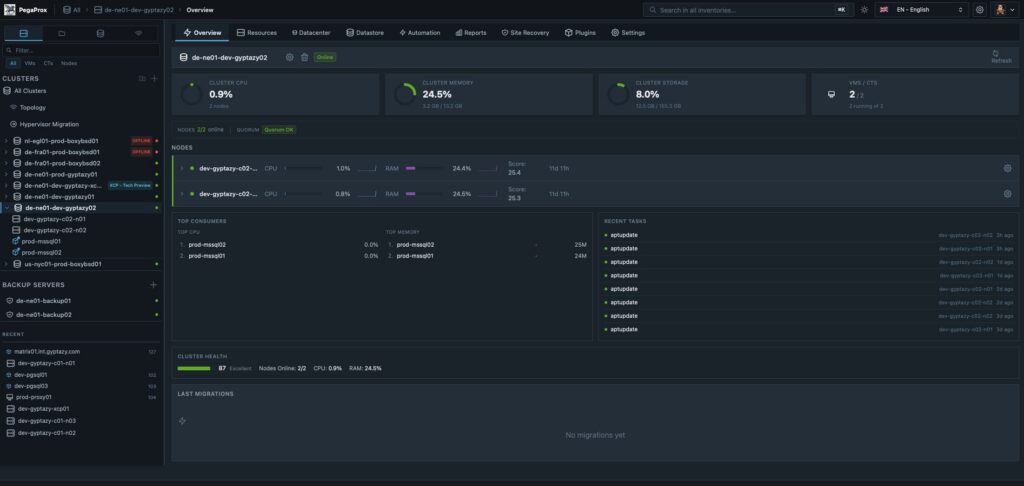
PegaProx for Proxmox: Cluster Overview
Developed by a small, focused team with strong practical relevance, which includes our colleague Florian Paul Azim Hoberg (also known as gyptazy) as a core contributor, PegaProx places particular emphasis on real requirements from the enterprise environment. Functions such as managing multiple clusters as a logical unit, a global overview of snapshots including a clean-up function, or the dynamic distribution of workloads based on current resource data (ProxLB) are not theoretical concepts, but specifically developed solutions for productive use. The result is a platform that elevates Proxmox VE to a new level and offers companies a powerful, scalable, and understandable solution for their virtualization strategy.
What does PegaProx offer?
PegaProx combines a variety of functions specifically developed for the professional operation of Proxmox VE-based infrastructures. The focus is clearly on central control, automation, and transparency across multiple clusters. Instead of fragmented tools, an integrated platform emerges that simplifies daily operations and reliably maps complex enterprise requirements.
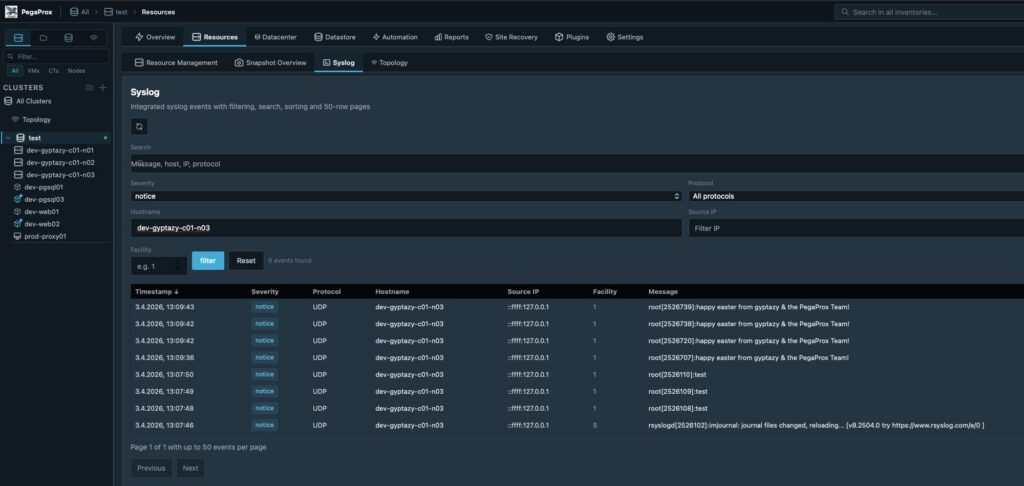
PegaProx with central, aggregated logging overview
To align this with the ProxTools Collection, created by @gyptazy, such as ProxLB, ProxCLMC, ProxPatch, ProxSnap, and ProxLog, have also been integrated and now offer a way to administer them via PegaProx’s graphical interface for easy usability. Key functions include:
- Multi-Cluster Management
- Unified Dashboard
- Multi-Tenancy & End-User Self-Service Portal
- Live Metrics
- Cross-Cluster Load Balancing
- Live Migration
- Cross-Cluster Live Migration
- High Availability and Automatic Failover
- Snapshots and Snapshot Replication
- Centralized Snapshot Overview
- Backup Management including Verification
- Role-Based Access Control and Multi-Tenancy
- Integration of External Authentication Systems
- Automation and Scheduled Tasks
- Rolling Updates / Patch Management for Cluster Nodes
- Integrated Syslog Server
- Ceph Management
- Audit Logging and Monitoring Alerts
- and much more
This represents only some of the capabilities PegaProx already offers today. Many other functions and continuous developments constantly expand the platform, closely aligning with the real requirements of modern virtualization environments. A complete overview of all features, technical details, and current developments can be found on the official PegaProx GitHub page, where all functions are transparently documented and continuously updated.
Installation & Configuration of PegaProx
The installation of PegaProx is deliberately designed to be flexible, covering a wide range of environments and requirements. Whether for quick evaluation, integration into existing infrastructures, or productive enterprise use, PegaProx can be deployed in several ways and seamlessly integrated into existing Proxmox VE landscapes. All installation methods pursue the same goal: the simplest, most reproducible, and transparent deployment possible without unnecessary complexity.
The following options are available for installation:
- Bash Script
A quick and easy way to get started using an automated installation script (however, we strongly advise against this method, even though it is becoming increasingly popular again):curl -sSL https://raw.githubusercontent.com/PegaProx/project-pegaprox/refs/heads/main/deploy.sh | sudo bash - Docker Container Image
Deployment as a container for maximum portability and easy integration into existing container environments - LXC Appliance
Prebuilt LXC template for direct use in Proxmox VE with minimal setup effort - VM Appliance
Fully preconfigured virtual machine for fast and isolated commissioning - Debian Package
Native installation via a Debian package for systems that are intentionally to be operated without containers - Debian Repository
Central package source for easy updates, versioning, and integration into existing package management processes
Regardless of the chosen method, the basic configuration is quickly completed, so PegaProx is available as a central management platform for multiple Proxmox VE clusters within a very short time.
Conclusion
PegaProx is rapidly developing into one of the most exciting solutions in the field of Proxmox VE-based virtualization and is already generating great enthusiasm in the community. Many companies already see PegaProx as the central platform they have been missing in the Proxmox ecosystem, especially when it comes to multi-cluster management, automation, and a consistent overall overview.
The clear structure, practical range of functions, and consistent focus on real requirements in the enterprise environment clearly demonstrate the platform’s potential. PegaProx not only closes existing gaps but also defines a new standard in many areas for managing complex virtualization landscapes.
Despite this positive development, it should be noted that PegaProx is currently still in its beta phase. Even though much already functions stably and thoughtfully, problems or unexpected behavior can occur at any time. For productive environments, its use should therefore be carefully considered and, if necessary, first implemented in test or staging scenarios.
Errors, wishes, or suggestions for improvement can be reported at any time via the project on GitHub. Additionally, the developers are available directly via the gyptazy projects Discord server for exchange and support.
| Categories: | Proxmox Virtualization |
|---|---|
| Tags: | gyptazy PegaProx proxmox Virtualization |

About the author
gyptazy
Senior DevOps Consultant
about the person
In my tech repertoire, FreeBSD and federated services stand not just as a personal preference but as a symbol of a commitment to the ethos of open-source. I am a fervent believer in the symbiotic relationship between developers including DevOps, SysOps and the open source community. As I continue to lead teams in the ever-evolving landscape of technology, their dedication to open-source contributions and advocacy for decentralized and federated services echoes not only in the code they write but in the ethos they instill within the teams.
