CERN PGDay 2026 took place on Friday, February 6, 2026, at CERN campus in Geneva, Switzerland. This was the second annual PostgreSQL Day at CERN, co-organized by CERN and the Swiss PostgreSQL Users Group. The conference offered a single-track schedule of seven sessions (all in English), followed by an on-site social event for further networking in the inspiring environment of CERN. With around 100 participants, this is already a very large PostgreSQL event for Switzerland. But what made this event absolutely special was its location. Hosting a database conference at CERN – one of the world’s leading science laboratories – provided a unique experience for everyone.
The third annual PGDay UK was (again) held at the Cavindish Conference Center in London this year, and I participated for the first time with an updated English version of my PGConf.DE talk, “PostgreSQL Performance Tuning”.
The conference is a one-day, one-track event with an auditorium and a sponsor hall for breaks. Around 75 visitors participated in this year’s conference.
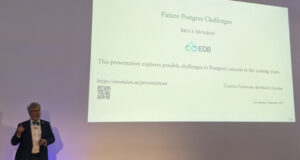
After the welcome session, the first talk was by Bruce Momjian on “Future Postgres Challenges” – a thoughtful compilation on the current status and possible future challenges for Postgres. It looks like the project is currently healthy, and some of the cautionary tales he cited from other open source projects (CentOS, GCC fork, etc.) probably will not apply to Postgres, at least not for a long while. He also mentioned some technological challenges however, and this part (especially attracting young talent to a C code base) looks more worrisome.
Besides the talks, there were also ample discussions with the participants, sponsors and other speakers. I had long discussions with Michael Christofides from pgMustard about his Postgres.FM podcast, and with our ex-colleague Robert Treat, besides others.

After the conference, some of the participants moved over to a nearby pub for beers and further socializing. Many of the speakers, sponsors and organizers travelled onwards the next day to PGDay Lowlands, which took place later in the week in Rotterdam (see our report from that event here). All in all, this was a very successful (albeit smallish) event.
On Friday, September 12th, we attended PGDay Lowlands 2025 in Rotterdam and it was definitely a conference to remember. It took place at the Blijdorp Zoo in Rotterdam, in the Oceanium building. It was an unforgettable experience to discuss databases while surrounded by various fish, sharks, and rays. Our company credativ GmbH, as an enterprise-grade open-source support provider for PostgreSQL, was a sponsor of the event and we had a booth there to meet attendees. Our CTO Alexander Wirt and our PostgreSQL expert Joop Boonen met visitors on our booth and discussed with them many technical aspects of PostgreSQL.
My Talk about Database Corruption
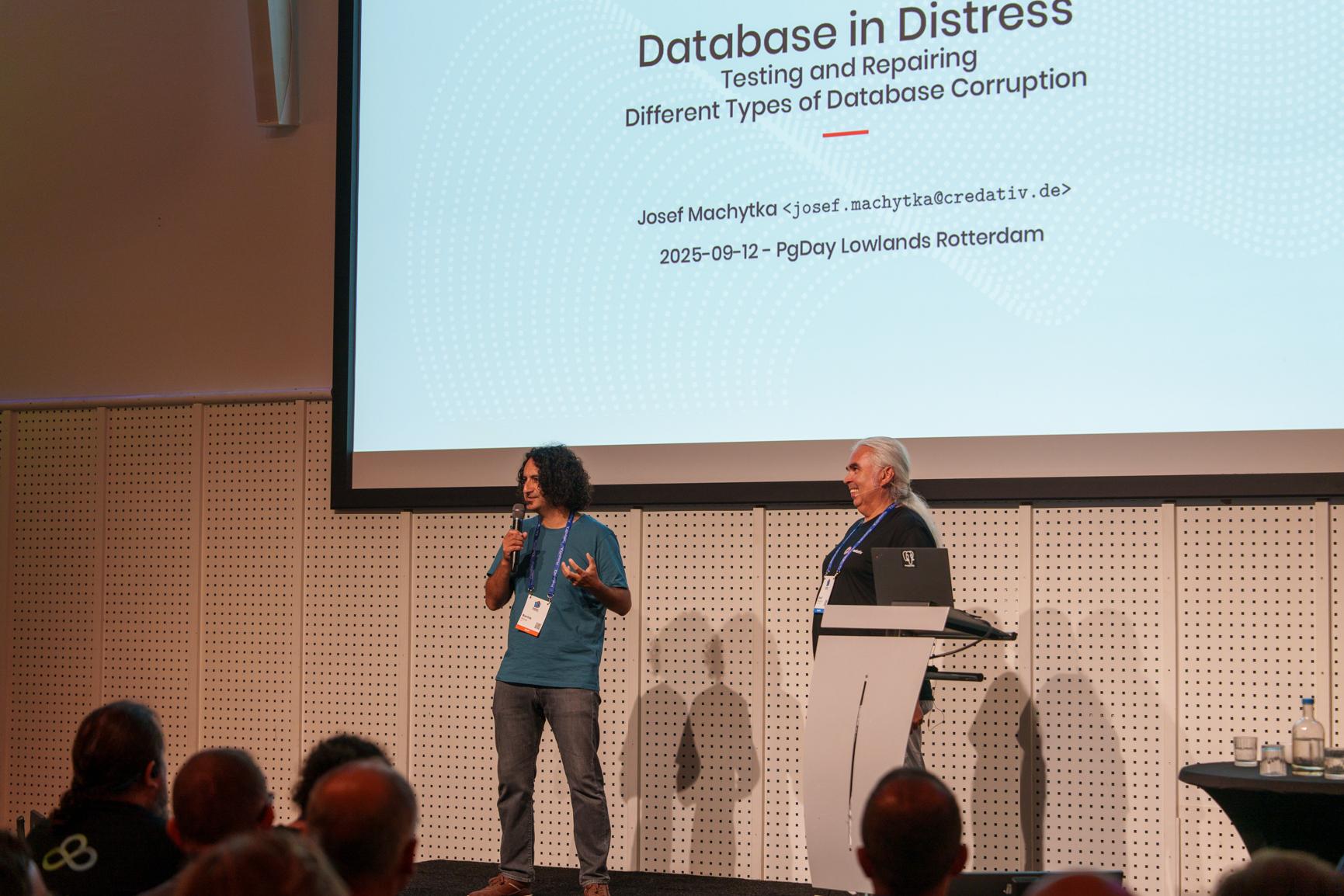
I represented our company also as a speaker, giving a talk titled “Database in Distress: Testing and Repairing Different Types of Database Corruption.” This talk summarized my experiences with database corruption. I’ve seen many corruption issues while repairing live systems. So I built a Python corruption simulator, which surgically damages selected parts of a data block in a testing table, and I used different PostgreSQL extensions to analyze these cases. The talk walked through examples of page-level corruption and discussed strategies for recovery. At the end of my talk, I discussed potential new Postgres features or settings that could make repairs less painful in the future. After the talk, many attendees came to our booth to discuss their experiences with specific corruption cases, which also sparked greater interest in credativ’s services.
Other Talks and Highlights
- Opening remarks – Boriss Mejias, as the organizer and guide, opened the conference by emphasizing the value of the community around PostgreSQL. Personally,
- Jimmy Angelakos – “How Do We Get Postgres to the Next Level?”
This talk was inspired by the one given by Simon Riggs in December 2023 in Prague. Jimmy offered different insights to keep improving PostgreSQL by making it more modular, boosting test coverage, creating a team specialized only in performance issues, and adding some new cutting-edge features. In particular, he mentioned goals like 100% regression testing, online major-version upgrades, and optional multi-threading – all part of a roadmap to solidify PostgreSQL’s lead. - Gulçin Yıldırım Jelinek – “Anatomy of Table-Level Locks in PostgreSQL”
This was an intermediate deep dive into DDL locks: explaining Access Share, Exclusive, Access Exclusive locks, and how they queue during ALTER or DROP commands. She showed how to interpret lock waits and deadlocks, and shared practical tips (like using online schema-change tools) to achieve near-zero downtime during migrations. - Chris Ellis – “Fun With UUIDs“
I very much enjoyed this talk. UUIDs have a bad reputation, mostly because randomly allocated UUIDs negatively affect indexes. But UUIDs also give us 16 bytes of space to play with, which can be to our advantage. Chris showed how to use the space of UUIDs to structure and encode data within identifiers to distinguish tenants, shards, or partitions. - Johannes Paul – “Actual trees, not b-trees – how I found PostgreSQL through PostGIS”
Speaker charmed the auditorium with the story of a neighbor’s climate-monitoring project mapping real-life tree data across Germany. Because he needed efficient geographic searches, Johannes switched to using PostGIS on PostgreSQL for his web app. - Dirk Krautschick – “Beyond Postgres – Insights about the PostgreSQL Extensibility”
Dirk emphasized that Postgres is designed to be lightweight yet powerful via extensions. He explained the extension framework and sketched out how to write a new extension for extra functionality. - Andreas Scherbaum – “What I learned interviewing the PostgreSQL Community”
I enormously enjoyed this talk . Andreas has been running the postgresql.life interview series and distilled some fun stats from them. It was a charming “state of the community” talk with interesting charts and quotes. - The final debate on “Autotuning in Postgres” was also very interesting. The PRO side (Luigi Nardi, Gianni Ciolli) argued that autotuning tools can save DBAs hours of manual work. But the CON side (Mayuresh S. Bagayatkar, Guy Gyles) countered that blindly auto-changing settings might over-tune and even hurt performance, since machines lack the human context for every deployment and current AI has no concept of truth.
Reflections
PGDay Lowlands 2025 was a fantastic experience. The mix of deep technical content and the relaxed zoo setting made for a friendly, engaging atmosphere. It was great to meet so many users and contributors and to hear about real-world problems, and even pick up new ideas for future work. I’m proud that credativ could play a role in such a great community event. PostgreSQL continues to grow and evolve, with people thinking hard about different issues, from locks and extensions to automatic tuning, and the community’s energy is truly inspiring. We are already looking forward to PGDay Lowlands 2026!
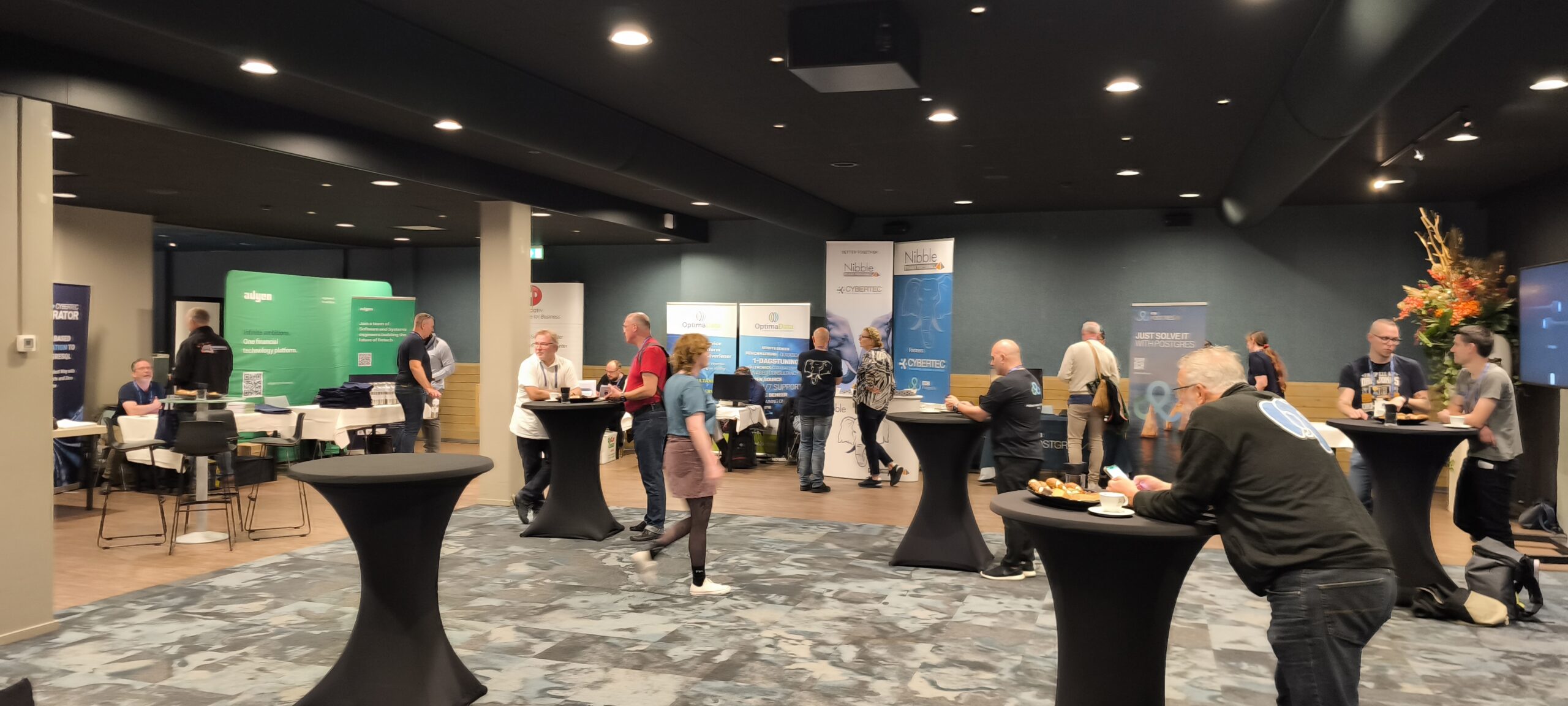
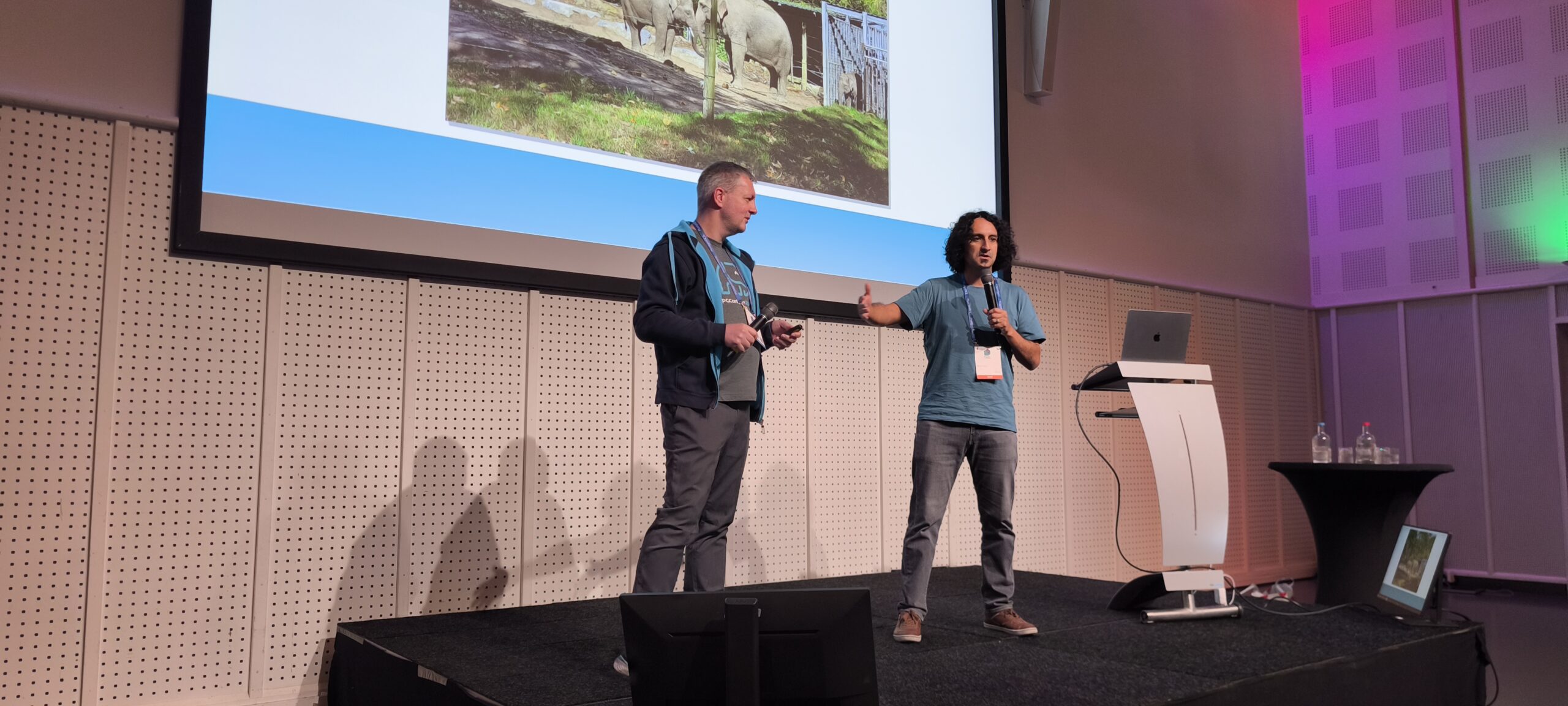
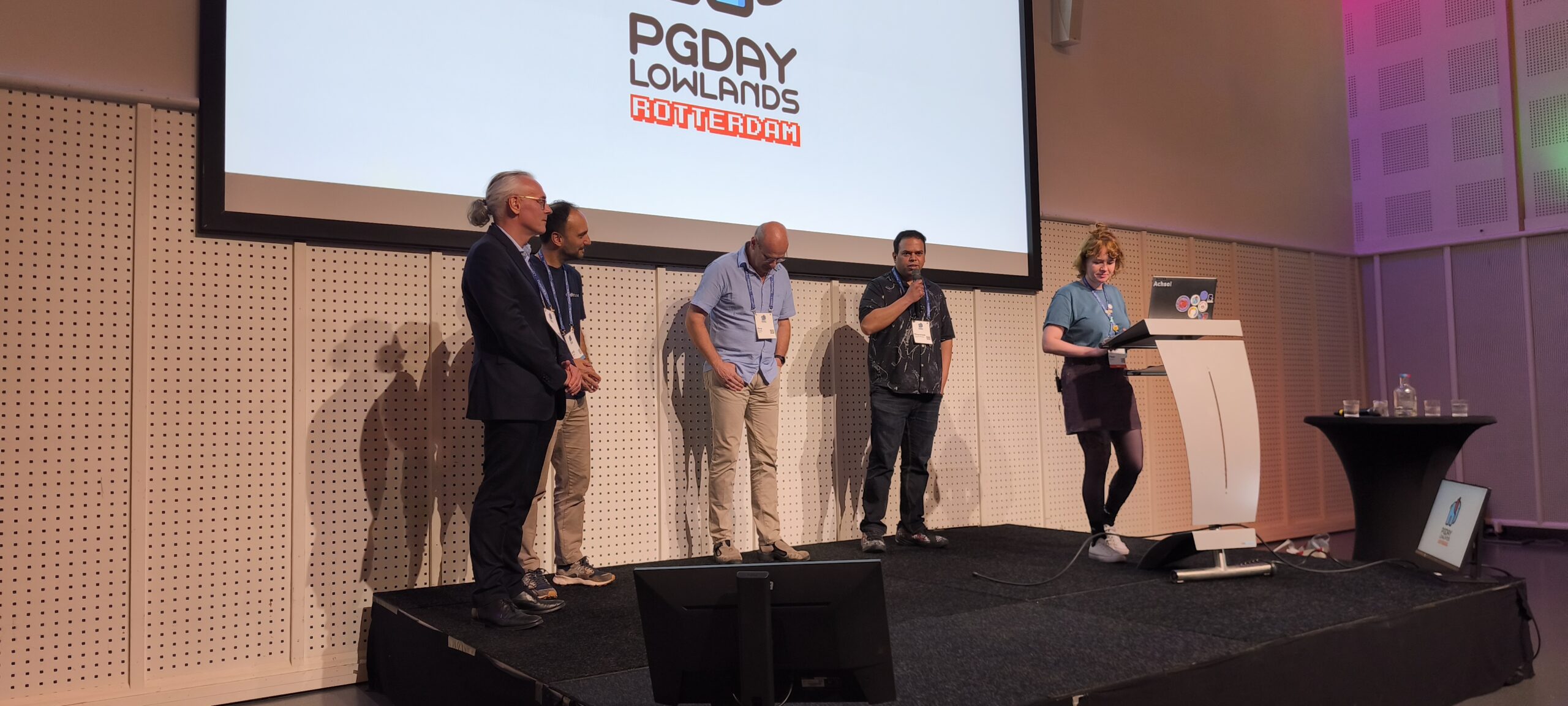

Photos (c) credativ GmbH or PG Day Lowlands organizers
 On September 4, 2025, the third pgday Austria took place in the Apothecary Wing of Schönbrunn Palace in Vienna, following the previous events in 2021 and 2022.
153 participants had the opportunity to attend a total of 21 talks and visit 15 different sponsors, discussing all possible topics related to PostgreSQL and the community.
Also present this time was the Sheldrick Wildlife Trust, which is dedicated to rescuing elephants and rhinos. Attendees could learn about the project, make donations, and participate in a raffle.
The talks ranged from topics such as benchmarking and crash recovery to big data.
Our colleague was also represented with his talk “Postgres with many data: To MAXINT and beyond“.
As a special highlight, at the end of the day, before the networking event, and in addition to the almost obligatory lightning talks, there was a “Celebrity DB Deathmatch” where various community representatives came together for a very entertaining stage performance to find the best database in different disciplines. To everyone’s (admittedly not great) surprise, PostgreSQL was indeed able to excel in every category.
Additionally, our presence with our own booth gave us the opportunity to have many very interesting conversations and discussions with various community members, as well as sponsors and visitors in general.
For the first time, the new managing director of credativ GmbH was also on site after our re-independence and saw things for himself.
All in all, it was a (still) somewhat smaller, but nonetheless, as always, a very instructive and familiar event, and we are already looking forward to the next one and thank the organizers and the entire team on site and behind the scenes.
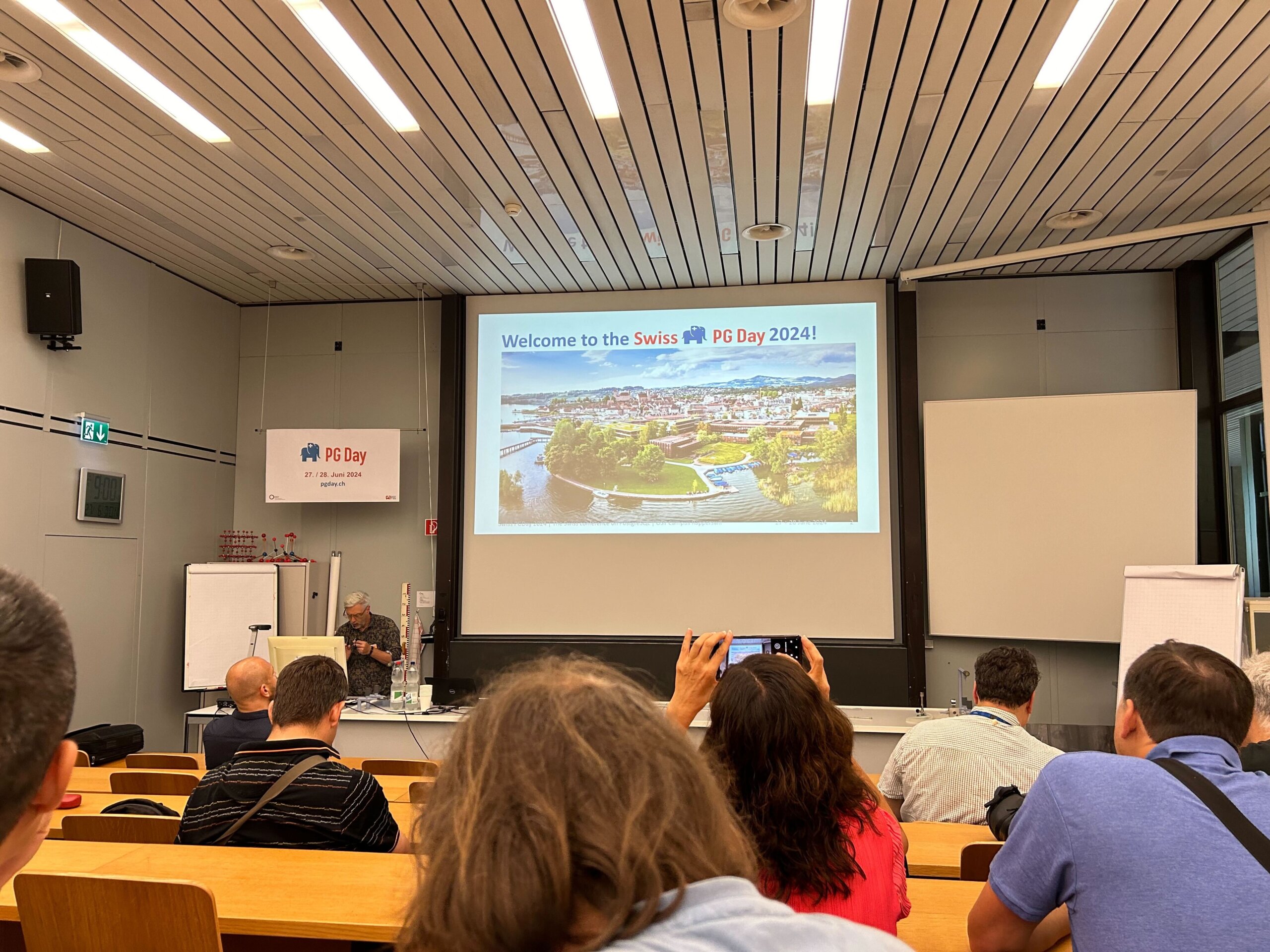
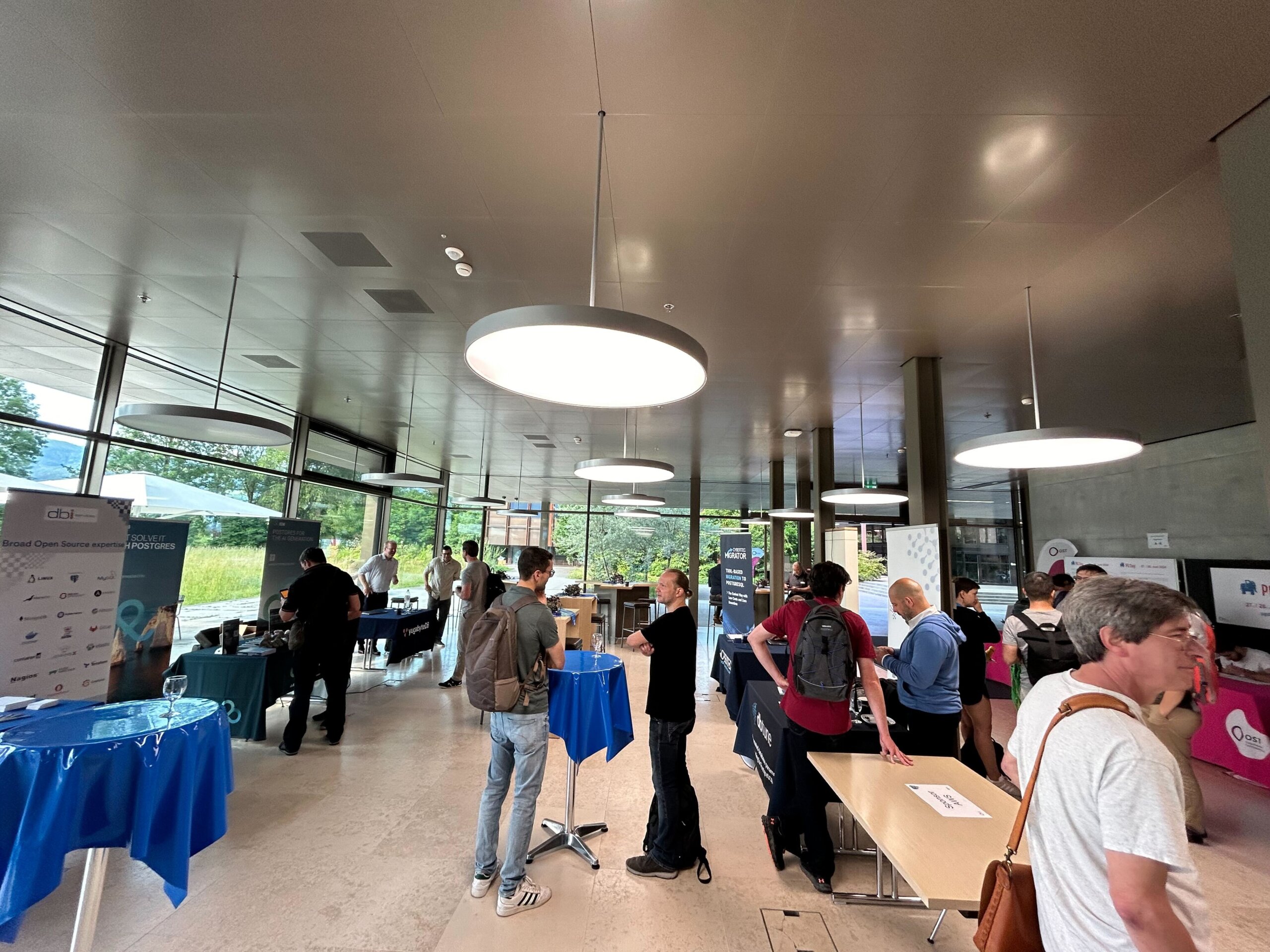
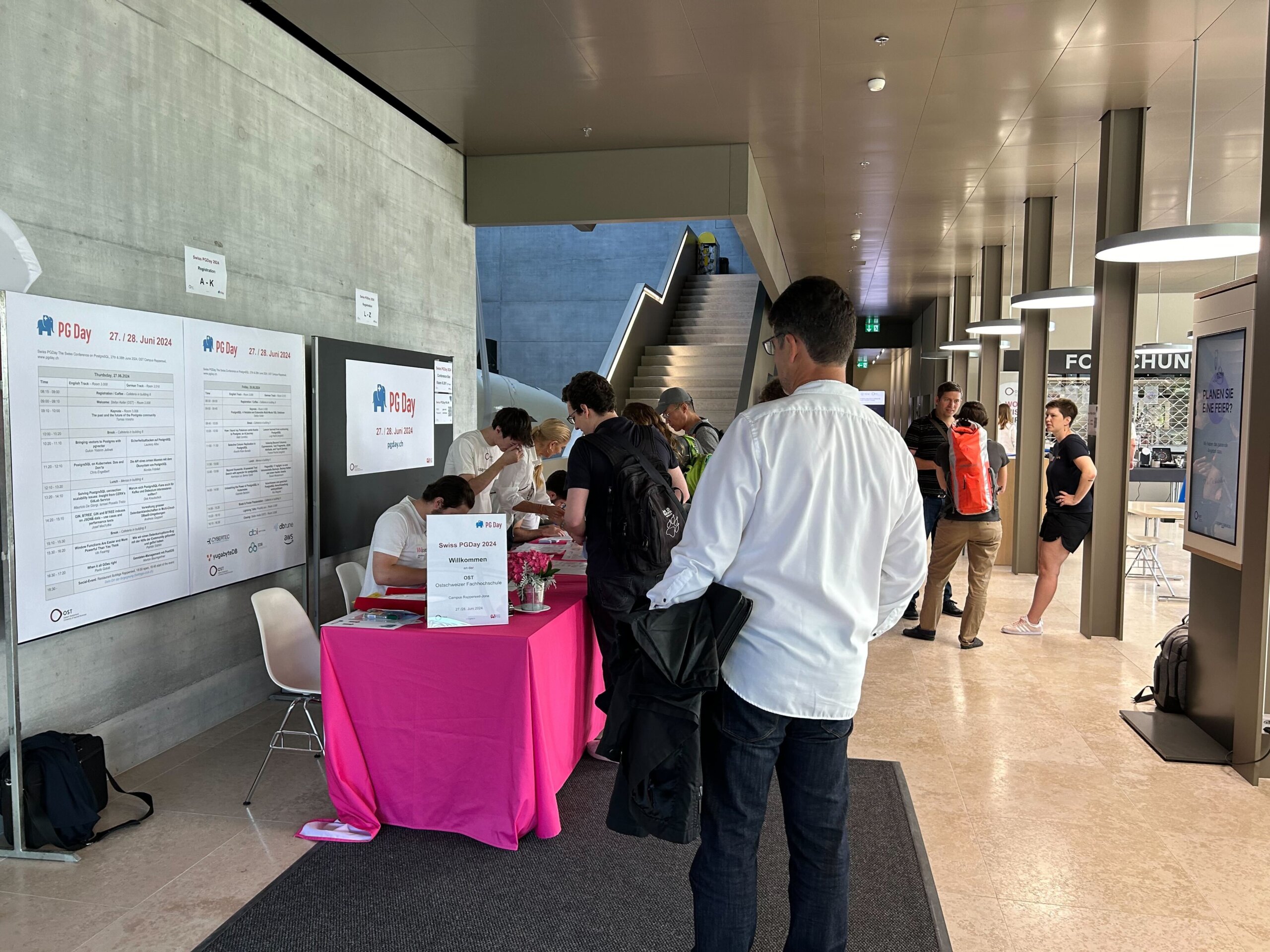
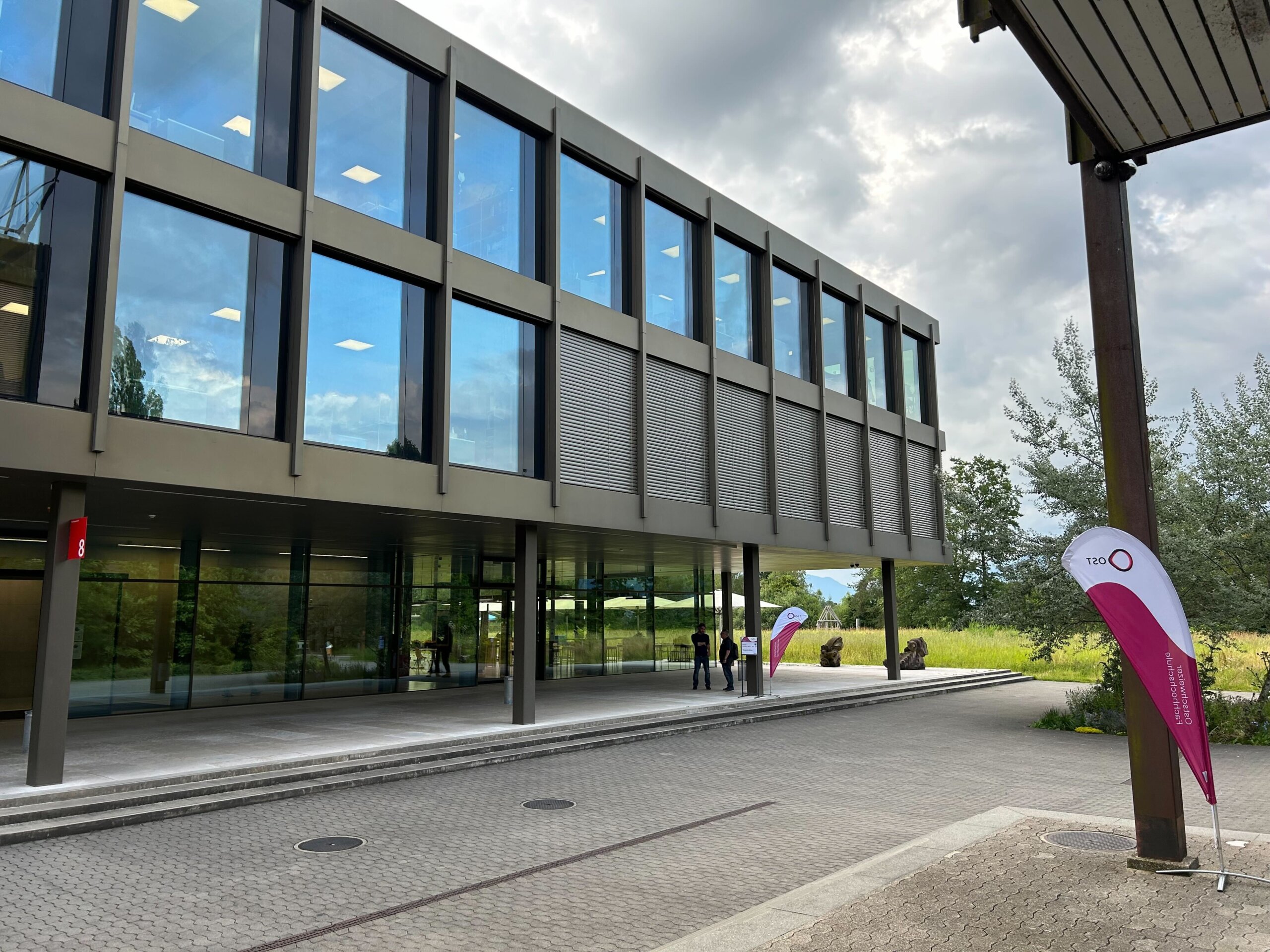
On Thursday, 27 June, and Friday, 28 June 2024, I had the amazing opportunity to attend Swiss PGDay 2024. The conference was held at the OST Eastern Switzerland University of Applied Sciences, Campus Rapperswil, which is beautifully situated on the banks of Lake Zurich in a nice, green environment. With approximately 110 attendees, the event had mainly a B2B focus, although not exclusively. Despite the conference being seemingly smaller in scale compared to PostgreSQL events in larger countries, it actually reflected perfectly the scope relevant for Switzerland.
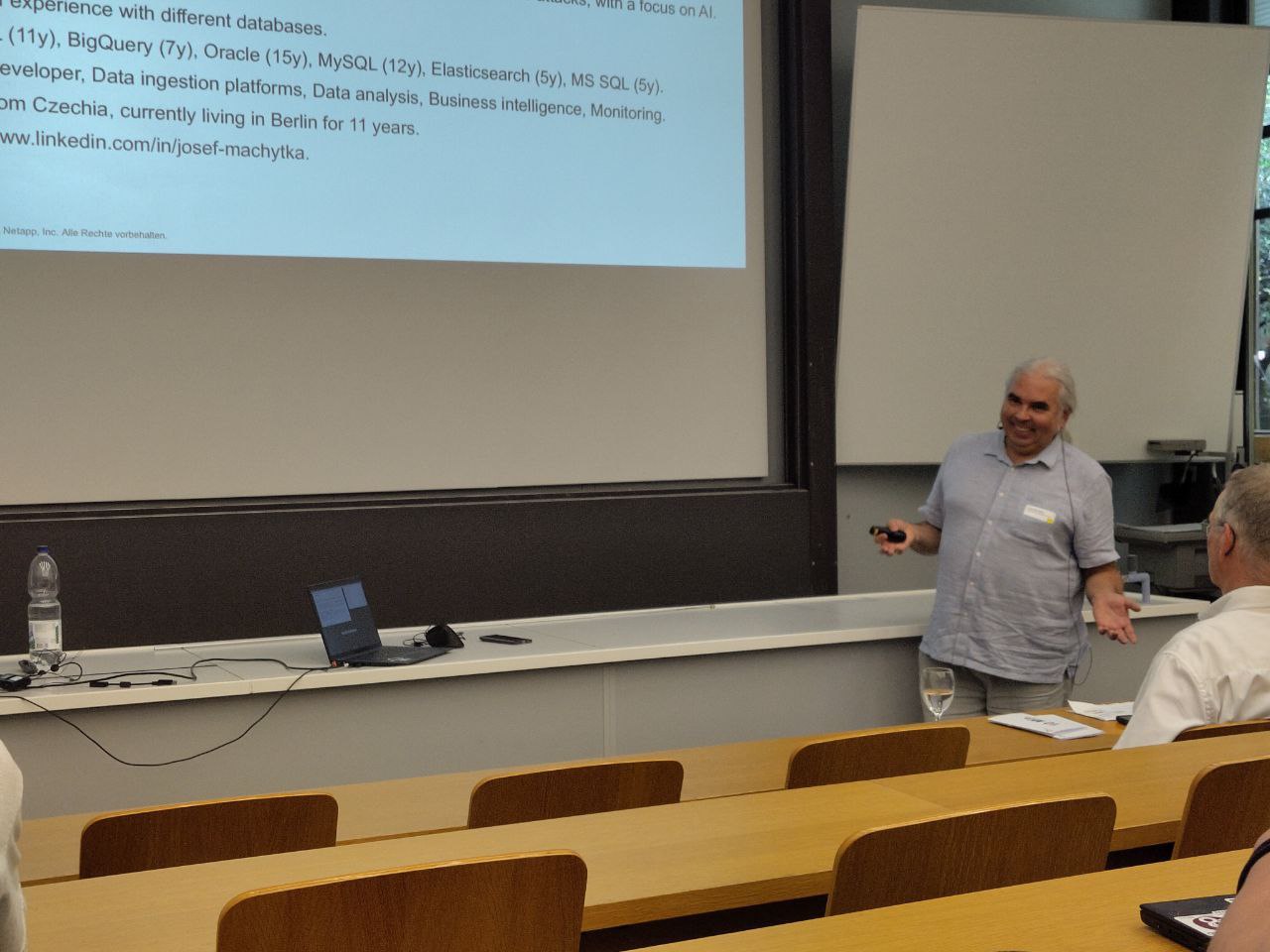
During the conference, I presented my talk “GIN, BTREE_GIN, GIST, BTREE_GIST, HASH & BTREE Indexes on JSONB Data“. The talk summarized the results of my long-term project at NetApp, including newer interesting findings compared to the presentation I gave in Prague at the beginning of June. As far as I could tell, my talk was well received by the audience, and I received very positive feedback.
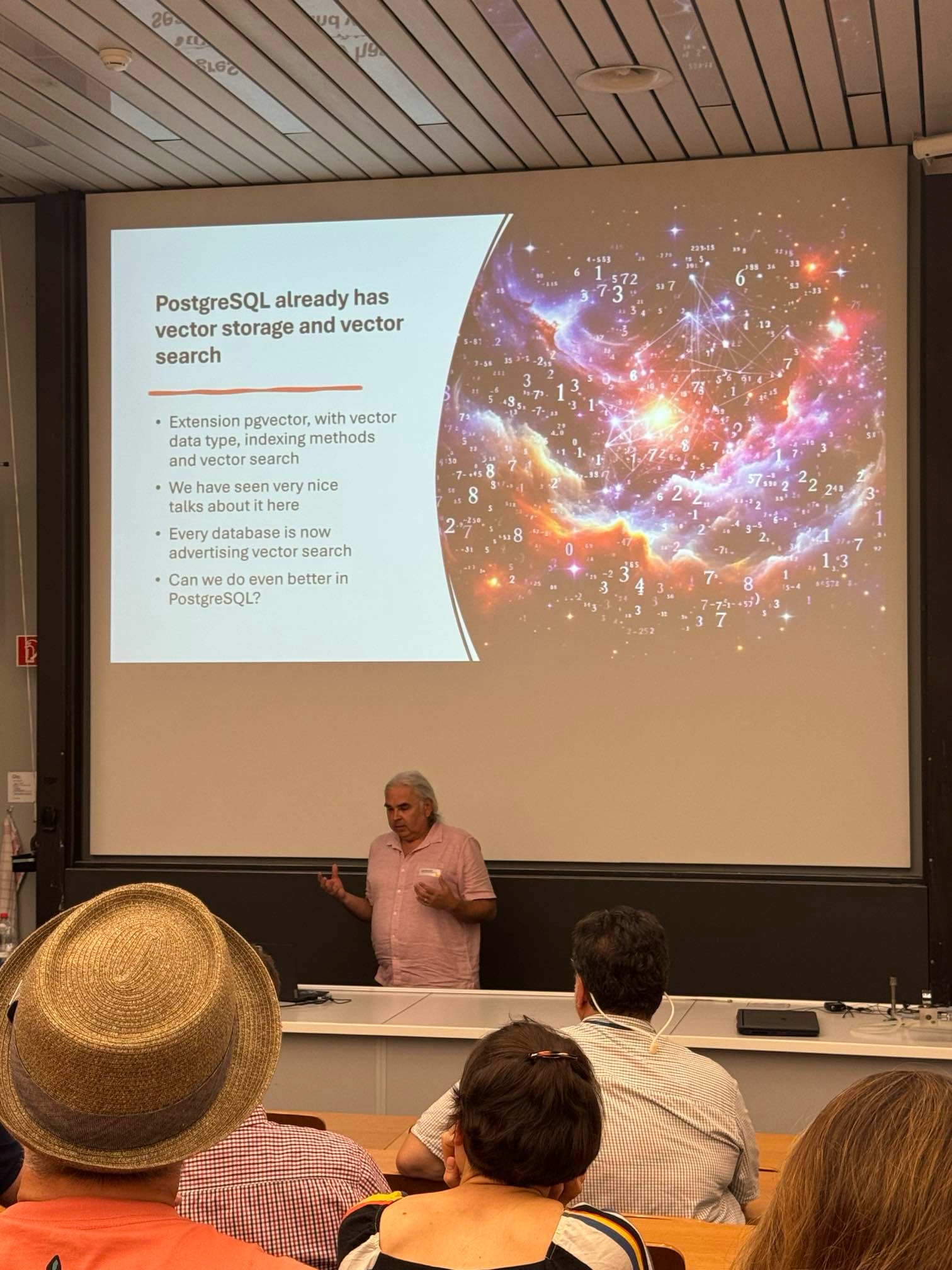
At the very end on Friday, I also presented a lightning talk, “Can PostgreSQL Have a More Prominent Role in the AI Boom?” (my slides are at the end of the file). In this brief talk, I raised the question of whether it would be possible to implement AI functionality directly into PostgreSQL, including storing embedding models and trained neural networks within the database. Several people in the audience, involved with ML/AI, reacted positively on this proposal, acknowledging that PostgreSQL could indeed play a more significant role in ML and AI topics.
The conference featured two tracks of presentations, one in English and the other in German, allowing for a diverse range of topics and speakers. I would like to highlight some of them:
- Tomas Vondra presented “The Past and the Future of the Postgres Community“, explaining how work on PostgreSQL changes and fixes is organized in Commitfests and discussing future development ideas within the community.
- Laurenz Albe’s talk, “Sicherheitsattacken auf PostgreSQL“, highlighted several potential attack vectors in PostgreSQL, capturing significant attention with surprising examples.
- Chris Engelbert’s presentation, “PostgreSQL on Kubernetes: Dos and Don’ts“, addressed the main issues related to running PostgreSQL on Kubernetes and discussed solutions, including pros and cons of existing PostgreSQL Kubernetes operators.
- Maurizio De Giorgi and Ismael Posada Trobo discussed “Solving PostgreSQL Connection Scalability Issues: Insights from CERN’s GitLab Service“, detailing the challenges and solutions for scalability in CERN’s vast database environment.
- Dirk Krautschick’s talk, “Warum sich PostgreSQL-Fans auch für Kafka und Debezium interessieren sollten?“, showcased examples of using Debezium connectors and Kafka with PostgreSQL for various use cases, including data migrations.
- Patrick Stählin discussed “Wie wir einen Datenkorruptions-Bug mit der Hilfe der Community gefunden und gefixt haben,” addressing issues with free space map files after migration to PostgreSQL 16.
- Marion Baumgartner’s presentation, “Geodaten-Management mit PostGIS,” provided interesting details about processing geo-data in PostgreSQL using the PostGIS extension.
- Prof. Stefan Keller, one of the main organizers and a professor of Data Engineering at Rapperswil OST University, presented “PostgreSQL: A Reliable and Extensible Multi-Model SQL Database“, discussing the multi-model structure of PostgreSQL amid declining interest in NoSQL solutions.
- Luigi Nardi from DBTune presented “Lessons Learned from Autotuning PostgreSQL“, describing an AI-based performance tuning tool developed by his company.
- Kanhaiya Lal and Belma Canik delved into “Beyond Keywords: AI-powered Text Search with pgvector for PostgreSQL,” exploring the use of the pgvector extension to enhance full-text search capabilities in PostgreSQL.
- Gabriele Bartolini, the creator of the PostgreSQL Kubernetes Operator “CloudNativePG,” discussed the history and capabilities of this operator in his talk, “Unleashing the Power of PostgreSQL in Kubernetes“.
At the end of the first day, all participants were invited to a social event for networking and personal exchange, which was very well organized. I would like to acknowledge the hard work and dedication of all the organizers and thank them for their efforts. Swiss PGDay 2024 was truly a memorable and valuable experience, offering great learning opportunities. I am grateful for the chance to participate and contribute to the conference, and I look forward to future editions of this event. I am also very thankful to NetApp-credativ for making my participation in the conference possible.
Photos by organizers, Gülçin Yıldırım Jelínek and author: