
PGConf.DE 2025, the 9th Annual PostgreSQL Conference Germany, was held on May 8–9, 2025, at the Marriott Hotel near Potsdamer Platz in Berlin. The event interconnected PostgreSQL enthusiasts, developers, DBAs, and industry sponsors for two days of fascinating talks across four parallel tracks. It was the biggest event so far, with 347 attendees. The whole conference was very well organized, and therefore special thanks are due to all the organizers—in particular Andreas Scherbaum, the main organizer—for their efforts and hard work.
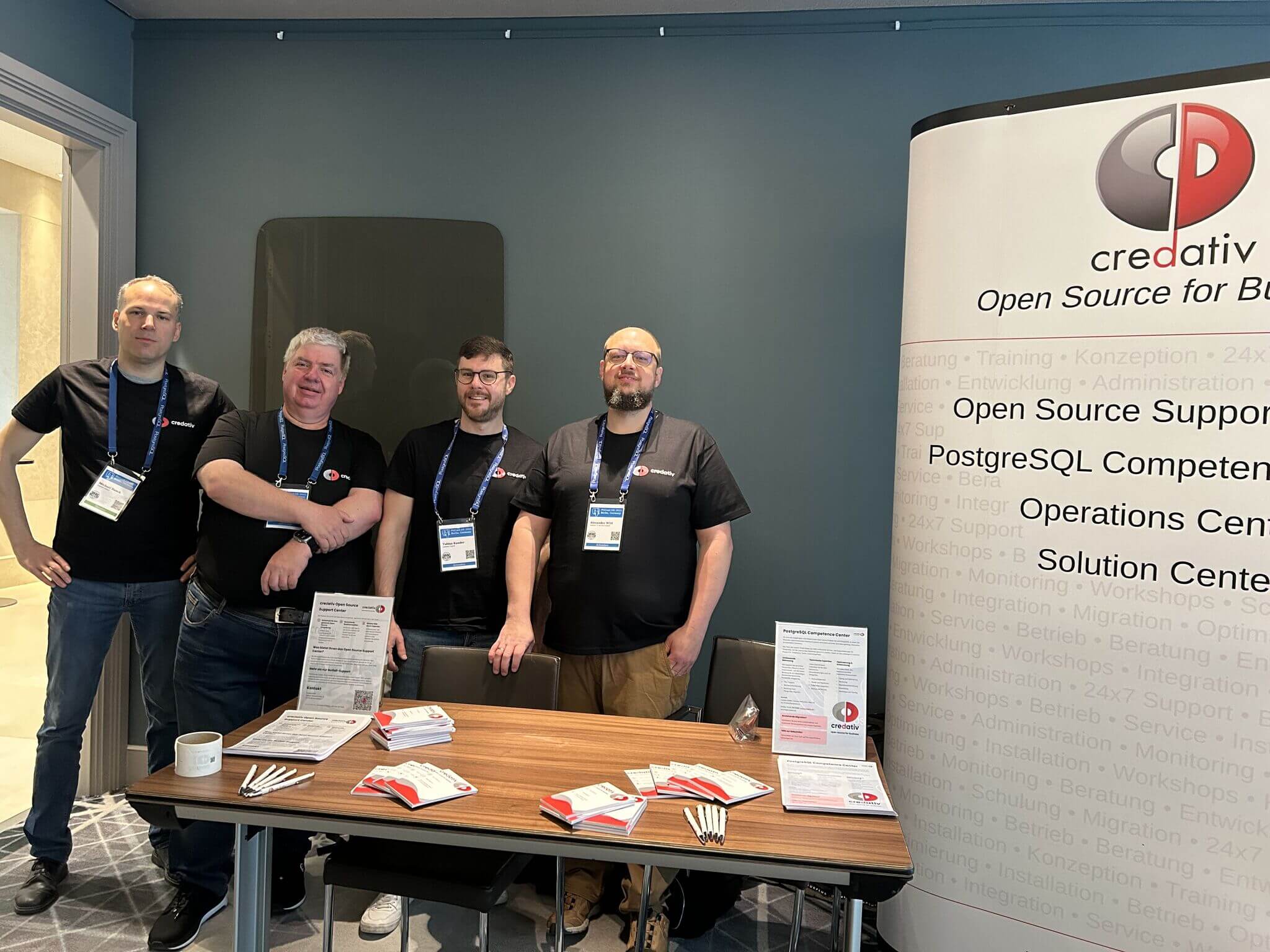
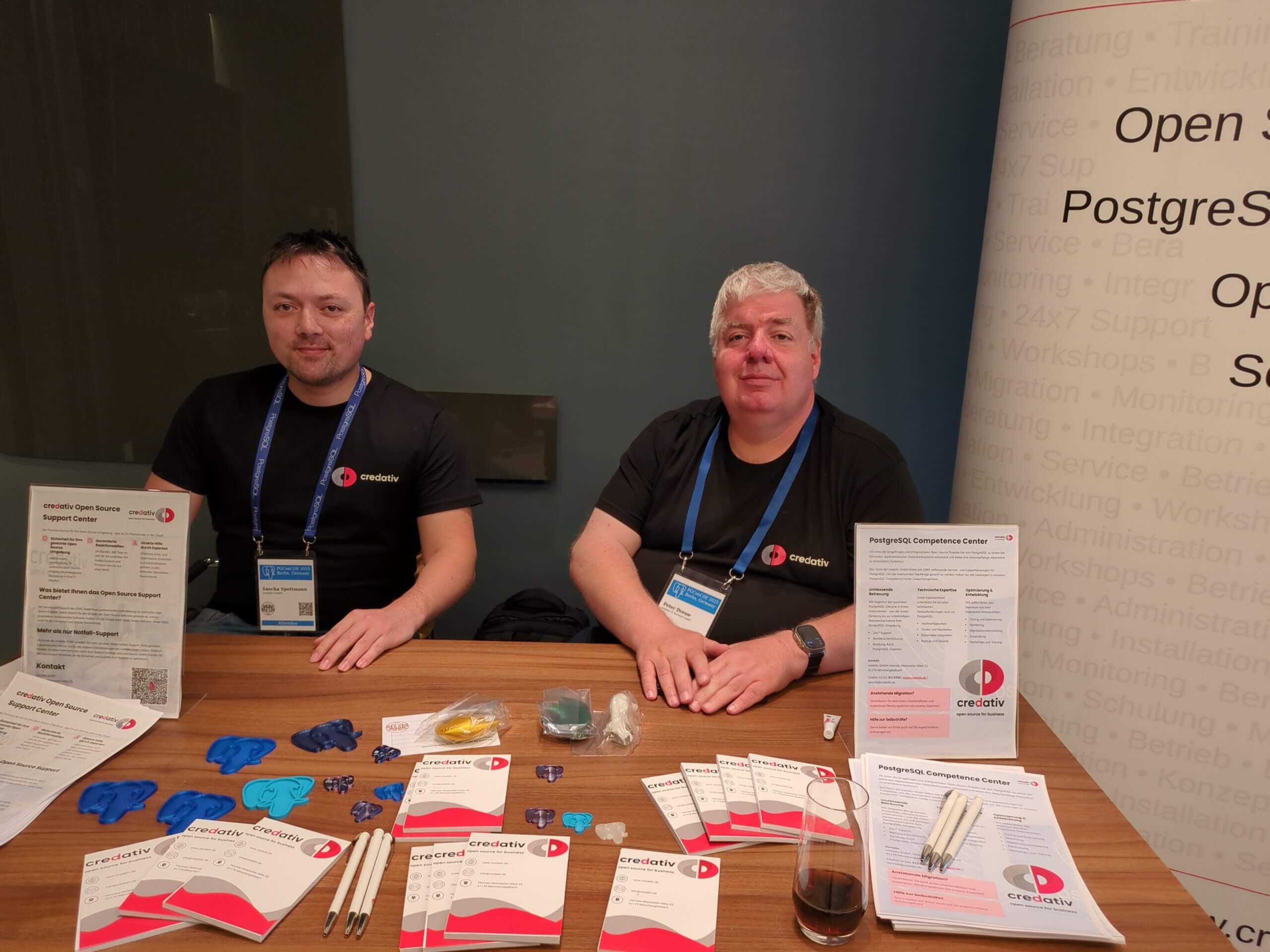
Our company, credativ GmbH, being independent again, participated as a gold sponsor. The credativ CTO Alexander Wirt, Head of Sales & Marketing Peter Dreuw and team leader of Database team Tobias Kauder, were available for attendees at the credativ booth. Many thanks to our team colleague Sascha Spettmann for delivering all the stands and billboards to the conference and back again.
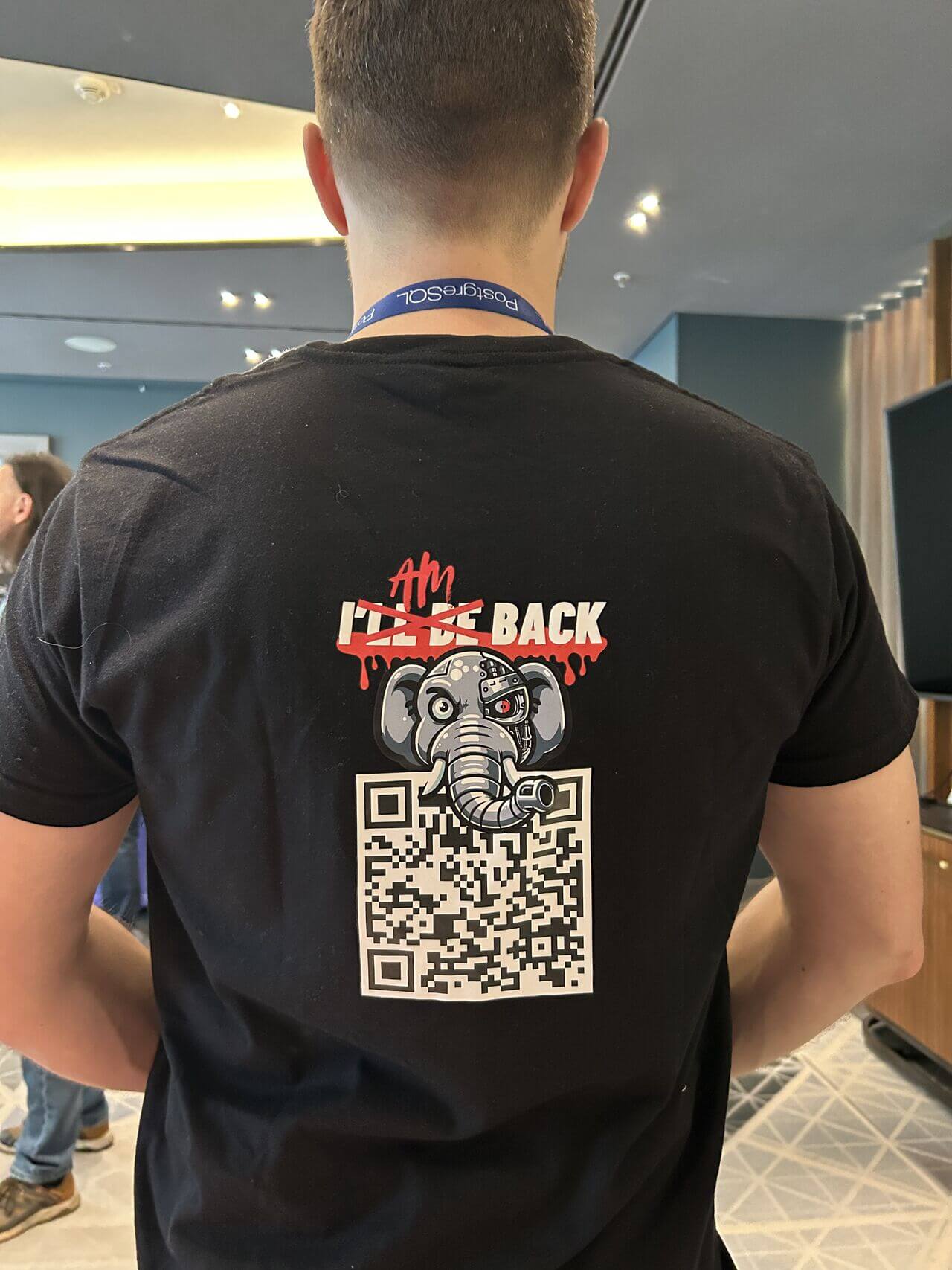
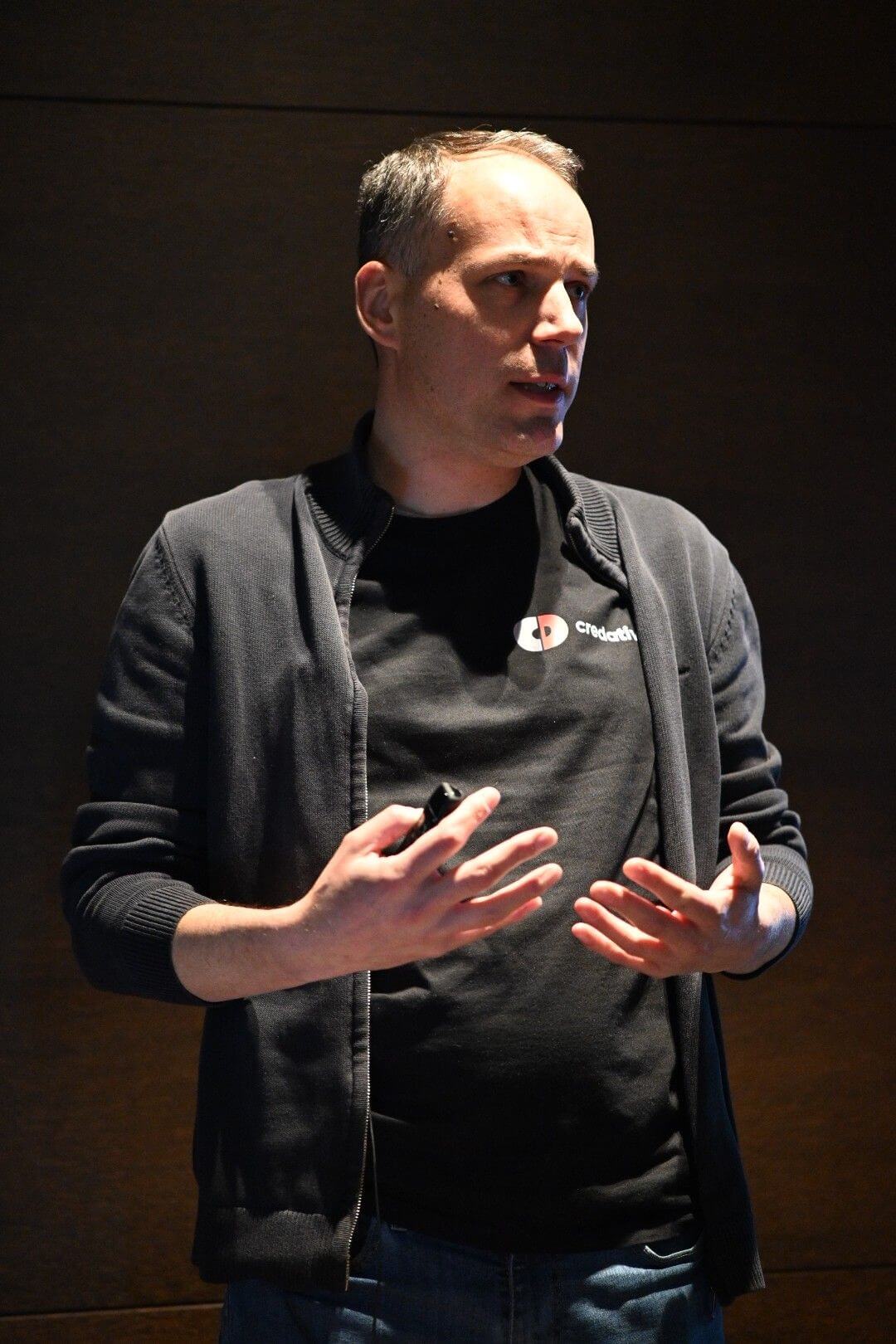
In total, we held four talks at the conference. Michael Banck, technical leader of our database team, presented the German-language talk “PostgreSQL Performance Tuning.” He provided a deep and comprehensive overview of the most important performance-tuning parameters in PostgreSQL and explained how they influence the database’s behavior. His talk attracted a large audience and was very well received.
I had an absolutely unique opportunity to present three different talks in the English track. In my regular talk “PostgreSQL Connections Memory Usage: How Much, Why and When,” I presented the results of my research and tests on PostgreSQL connections’ memory usage. After explaining the most important aspects of Linux memory management and measurements of memory usage reported by standard commands, I detailed PostgreSQL connection memory usage during query execution based on numbers reported in smaps files. I intend to publish detailed blog posts about my findings soon. My other talk, “Building a Data Lakehouse with PostgreSQL,” was originally chosen as a reserve talk in case of a last-minute cancellation. Unfortunately, this indeed happened: the talk “Creating a Board Game Chatbot with Postgres, AI, and RAG” by Matt Cornillon had to be replaced. The speaker could not attend because his flight was unexpectedly canceled at very short notice.
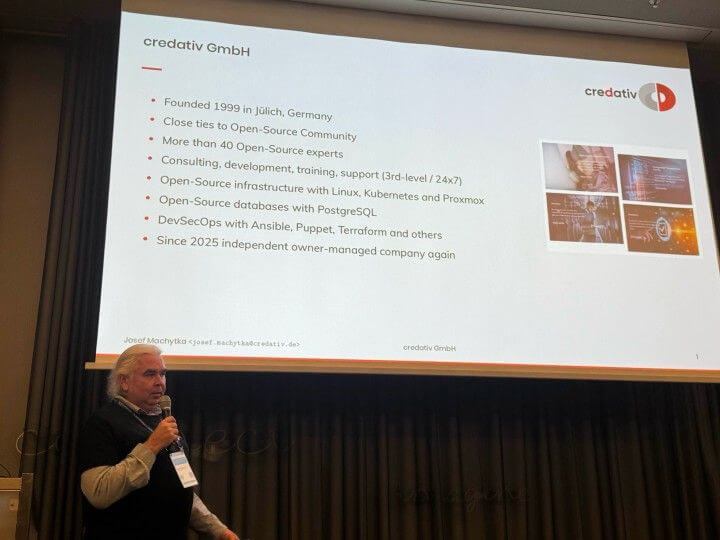
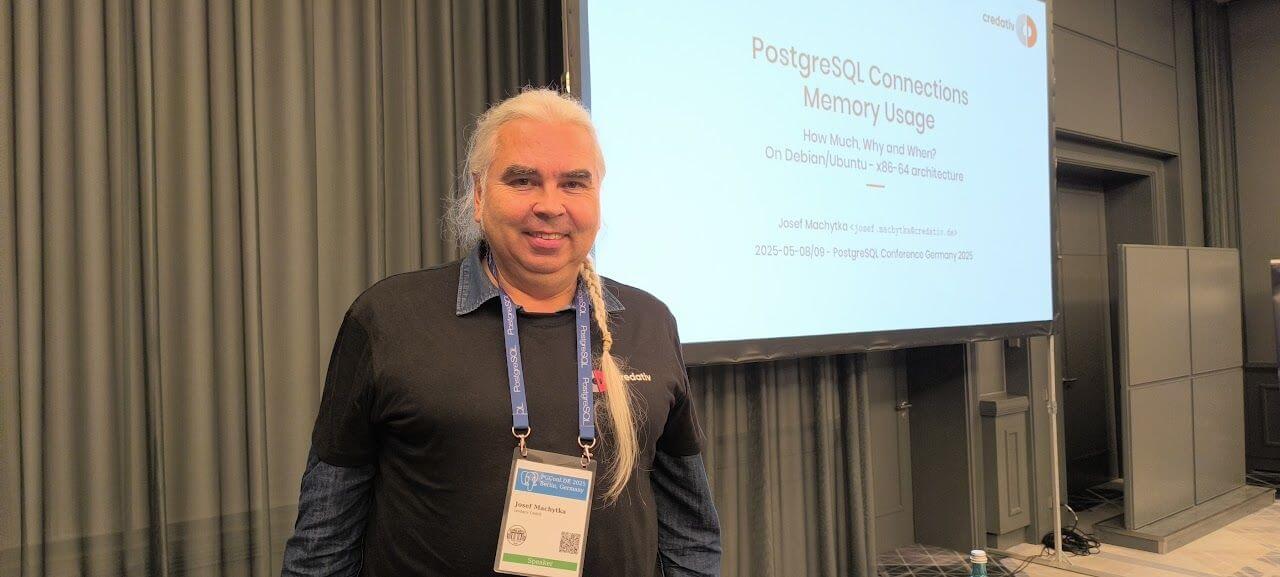
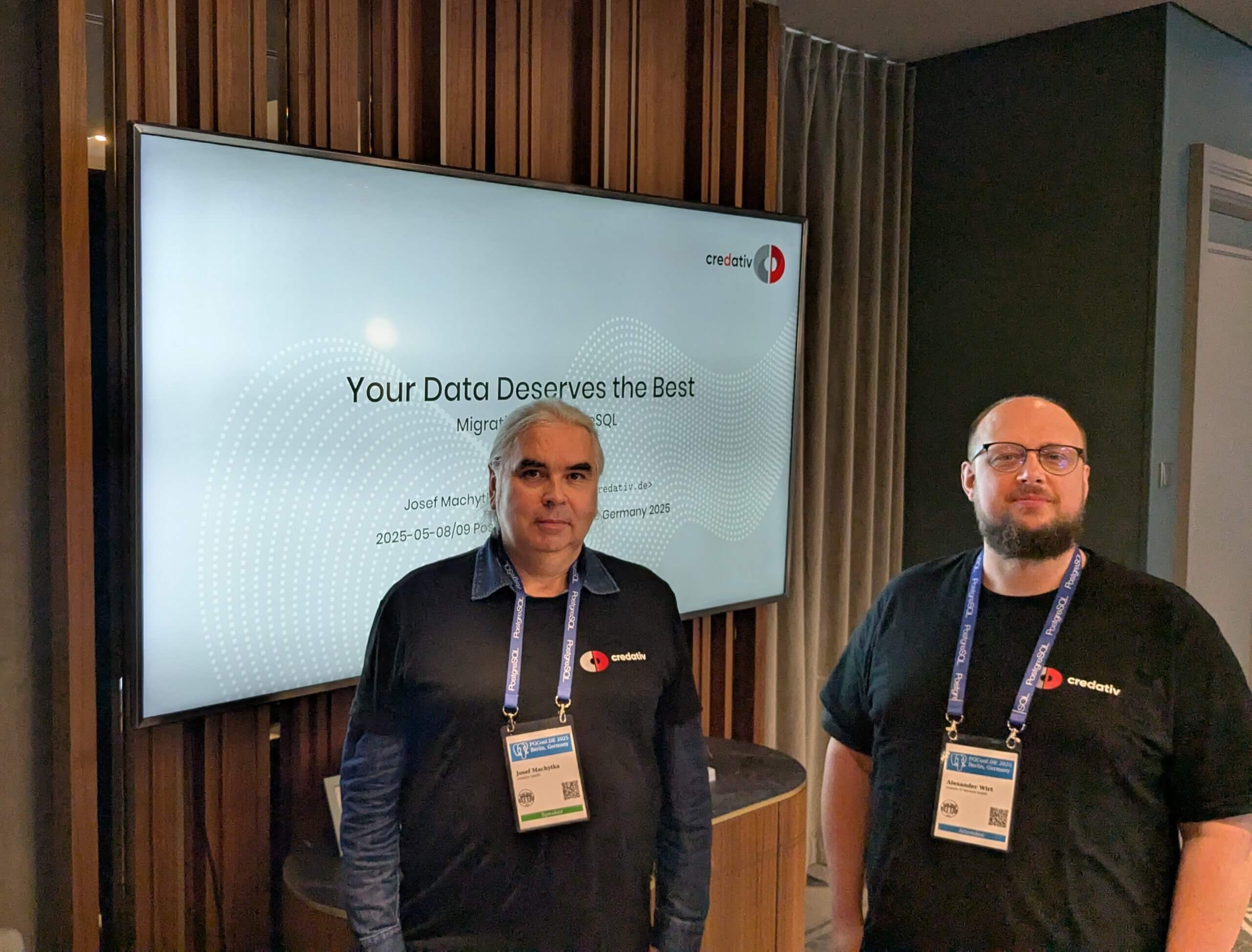
In the sponsor track, credativ CTO Alexander Wirt and I presented a talk titled “Your Data Deserves the Best: Migration to PostgreSQL.” It featured our new migration tool, “credativ-pg-migrator.” It is capable of migrating data models (tables, data, indexes, constraints, and views) from Informix, IBM DB2 LUW, MS SQL Server, Sybase ASE, SQL Anywhere, and MySQL/MariaDB. In the case of Informix, it can also convert stored procedures, functions, and triggers into PostgreSQL PL/pgSQL. We will share more details about this tool in a separate blog post.
Since there were always three or four parallel talks, I had to carefully choose which sessions to attend. I greatly enjoyed the talk “András in Windowsland – a DBA’s (mis)adventures” by András Váczi from Cybertec. The speaker presented many useful tips for accessing and troubleshooting PostgreSQL on Windows. I also enjoyed the German talk “Modern VACUUM,” delivered by Christoph Berg from Cybertec. He provided valuable insights into the history and implementation details of the VACUUM command and autovacuum background processes. Another very interesting talk was the German presentation “Modernes SSL ideal einsetzen” by Peter Eisentraut from EDB. The talk covered selecting appropriate protocol versions and cryptographic cipher suites, managing keys and certificates, and configuring client/server settings to meet contemporary security standards. The talk “Comparing the Oracle and PostgreSQL transaction systems,” delivered by Laurenz Albe from Cybertec, received a lot of well-deserved attention. Key topics included Oracle’s undo/redo mechanism versus PostgreSQL’s MVCC approach, differences in isolation level defaults and anomalies, and how each database implements constraints and transactional DDL. Last but not least, I want to mention the talk “What is an SLRU anyway?” delivered by major PostgreSQL contributor Álvaro Herrera. He explained that SLRUs are essentially circular logs with an in-memory cache used for tracking information such as committed transactions or snapshot data and he highlighted the significance of PostgreSQL 17’s innovations which made SLRU cache sizes configurable. Unfortunately, the talks were not recorded, but slides for the majority of the talks are already available on the conference website.
The whole event was highly informative and provided excellent networking opportunities. We are very much looking forward to participating in the next PGConf.DE. In the meantime, stay tuned to all credativ news, follow us on social media – LinkedIn and Mastodon.
If you are interested in our PostgreSQL related services, click here!
100% Open Source – 100% Cost Control
The PostgreSQL® Competence Center of the credativ Group announces the creation of a new comprehensive service and support package that includes all services necessary for the operation of PostgreSQL® in enterprise environments. This new offering will be available starting August 1st, 2020.
“Motivated by the requirements of many of our customers, we put together a new and comprehensive PostgreSQL® service package that meets all the requirements for the operation of PostgreSQL® in enterprise environments.”, says Dr. Michael Meskes, managing director of the credativ Group.
“In particular, this package focuses on true open source support, placing great emphasis on the absence of any proprietary elements in our offer. Despite this, our service package still grants all of the necessary protection for operation in business-critical areas. Additionally, with this new offering, the number of databases operated within the company’s environment does not matter. As a result, credativ offers 100% cost control while allowing the entire database environment to be scaled as required.”
Database operation in enterprise environments places very high demands on the required service and support. Undoubtedly an extremely powerful, highly scalable, and rock-solid relational database is the basis for secure and high-performance operation.
However, a complete enterprise operating environment consists of much more than just the pure database; one needs holistic lifecycle management. Major and Minor version upgrades, migrations, security, services, patch management, and Long-Term Support (LTS) are just a few essential factors. Additionally, staying up to date also requires continuous regular training and practice.
Services for the entire operating environment
Beyond the database itself, one also needs a stable and highly scalable operating environment providing all necessary Open Source tools for PostgreSQL and meeting all requirements regarding high availability, security, performance, database monitoring, backups, and central orchestration of the entire database infrastructure. These tools include the open-source versions of numerous PostgreSQL related project packages, such as pgAdmin, pgBadger, pgBackrest, Patroni, but also the respective operating system environment and popular projects like Prometheus and Grafana, or even cloud infrastructures based on Kubernetes.
Just as indispensable as the accurate functioning of the database is smooth interaction with any components connected with the database. Therefore it is important to include and consider these components as well. Only when all aspects, such as operating system, load balancer, web server, application server, or PostgreSQL cluster solutions, work together, will the database achieve optimal performance.
This new support package is backed up by continuous 24×7 enterprise support, with guaranteed Service Level Agreements and all necessary services for the entire database environment, including a comprehensive set of open-source tools commonly used in today’s enterprise PostgreSQL environments. All of these requirements are covered by the PostgreSQL Enterprise package from credativ and are included within the scope of services. The new enterprise service proposal is offered at an annual flat rate, additionally simplifying costs and procurement.
About credativ
The credativ Group is an independent consulting and services company with primary locations in Germany, the United States, and India.
Since 1999, credativ has focused entirely on the planning and implementation of professional business solutions using Open Source software. Since May 2006, credativ operates the Open Source Support Center (OSSC), offering professional 24×7 enterprise support for numerous Open Source projects.
In addition, our PostgreSQL Competence Center of credativ provides a dedicated database team a comprehensive service for the PostgreSQL object-relational database eco-system.
This article was originally written by Philip Haas.
The PostgreSQL® Global Development Group (PGDG) has released version 12 of the popular, free database PostgreSQL®. As our Beta 4 article already suggested, a multitude of new features, improvements, and optimizations have been incorporated into the release. These include:
Optimized storage utilization and speed for btree indexes
btree indexes, the standard index type in PostgreSQL®, have received several optimizations in PostgreSQL® 12.
Historically, btree indexes stored duplicates (i.e., multiple entries with the same key values) in an unsorted order. This resulted in suboptimal utilization of the physical representation in the affected indexes. An optimization now stores these multiple key values in the same order as they are physically stored in the table. This improves storage utilization and reduces the overhead for managing corresponding btree indexes. Furthermore, indexes with multiple indexed columns use an improved physical representation, which also enhances their storage utilization. To benefit from this in PostgreSQL® 12, these indexes must be rebuilt or reindexed if the upgrade to the new version was performed via binary upgrade using pg_upgrade.
Insert operations into btree indexes are also accelerated by improved locking.
Improvements for pg_checksums
credativ has contributed an extension for pg_checksums that allows activating or deactivating block checksums in stopped PostgreSQL® instances. Previously, this could only be done by recreating the physical data representation of the cluster via initdb.
pg_checksums now also features the ability to display a status history on the console with the parameter --progress. The corresponding code contributions come from colleagues Michael Banck and Bernd Helmle.
Optimizer Inlining of Common Table Expressions
Up to and including PostgreSQL® 11, the PostgreSQL® Optimizer was unable to optimize Common Table Expressions (also known as CTEs or WITH queries). If such an expression was used in a query, the CTE was always evaluated and materialized first before the rest of the query was processed. For more complex CTE expressions, this led to correspondingly expensive execution plans. The following generic example clearly illustrates this. Given a join with a CTE expression that filters all even numbers from a numeric column:
WITH t_cte AS (SELECT id FROM foo WHERE id % 2 = 0) SELECT COUNT(*) FROM t_cte JOIN bar USING(id);
In PostgreSQL® 11, the use of a CTE always leads to a CTE Scan, which materializes the CTE expression first:
EXPLAIN (ANALYZE, BUFFERS) WITH t_cte AS (SELECT id FROM foo WHERE id % 2 = 0) SELECT COUNT(*) FROM t_cte JOIN bar USING(id) ;
  QUERY PLAN
─────────────────────────────────────────────────────────────────────────────────────────────────────────────────────────
  Aggregate (cost=2231.12..2231.14 rows=1 width=8) (actual time=48.684..48.684 rows=1 loops=1)
  Buffers: shared hit=488
  CTE t_cte
  ->  Seq Scan on foo (cost=0.00..1943.00 rows=500 width=4) (actual time=0.055..17.146 rows=50000 loops=1)
  Filter: ((id % 2) = 0)
  Rows Removed by Filter: 50000
  Buffers: shared hit=443
  ->  Hash Join (cost=270.00..286.88 rows=500 width=0) (actual time=7.297..47.966 rows=5000 loops=1)
  Hash Cond: (t_cte.id = bar.id)
  Buffers: shared hit=488
  ->  CTE Scan on t_cte (cost=0.00..10.00 rows=500 width=4) (actual time=0.063..31.158 rows=50000 loops=1)
  Buffers: shared hit=443
  ->  Hash (cost=145.00..145.00 rows=10000 width=4) (actual time=7.191..7.192 rows=10000 loops=1)
  Buckets: 16384 Batches: 1 Memory Usage: 480kB
  Buffers: shared hit=45
  ->  Seq Scan on bar (cost=0.00..145.00 rows=10000 width=4) (actual time=0.029..3.031 rows=10000 loops=1)
  Buffers: shared hit=45
  Planning Time: 0.832 ms
  Execution Time: 50.562 ms
(19 rows)
This plan first materializes the CTE with a Sequential Scan with the corresponding filter (id % 2 = 0). No functional index is used here, so this scan is correspondingly more expensive. Afterwards, the result of the CTE is joined with the table bar via Hash Join with the corresponding Join condition. With PostgreSQL® 12, the optimizer now gains the ability to inline these CTE expressions without prior materialization. The underlying, optimized plan in PostgreSQL® 12 then looks like this:
EXPLAIN (ANALYZE, BUFFERS) WITH t_cte AS (SELECT id FROM foo WHERE id % 2 = 0) SELECT COUNT(*) FROM t_cte JOIN bar USING(id) ;
  QUERY PLAN
───────────────────────────────────────────────────────────────────────────────────────────────────────────────────────────────────────────
  Aggregate (cost=706.43..706.44 rows=1 width=8) (actual time=9.203..9.203 rows=1 loops=1)
  Buffers: shared hit=148
  ->  Merge Join (cost=0.71..706.30 rows=50 width=0) (actual time=0.099..8.771 rows=5000 loops=1)
  Merge Cond: (foo.id = bar.id)
  Buffers: shared hit=148
  ->  Index Only Scan using foo_id_idx on foo (cost=0.29..3550.29 rows=500 width=4) (actual time=0.053..3.490 rows=5001 loops=1)
  Filter: ((id % 2) = 0)
  Rows Removed by Filter: 5001
  Heap Fetches: 10002
  Buffers: shared hit=74
  ->  Index Only Scan using bar_id_idx on bar (cost=0.29..318.29 rows=10000 width=4) (actual time=0.038..3.186 rows=10000 loops=1)
  Heap Fetches: 10000
  Buffers: shared hit=74
  Planning Time: 0.646 ms
  Execution Time: 9.268 ms
(15 rows)
The advantage of this method is that the initial materialization of the CTE expression is omitted. Instead, the query is executed directly with a Join.
This works for all non-recursive CTE expressions without side effects (e.g., CTEs with write statements) and those that are referenced only once per query. The old optimizer behavior can be forced with the WITH ... AS MATERIALIZED ... statement.
Generated Columns
New in PostgreSQL ® 12 are so-called Generated Columns, which calculate a result based on existing column values using expressions. These are stored with the corresponding source values in the tuple. The advantage is that the creation of triggers for subsequent calculation of column values can be avoided. The following simple example, based on a price table with net and gross prices, illustrates the new functionality:
CREATE TABLE preise(netto numeric,
  brutto numeric GENERATED ALWAYS AS (netto * 1.19) STORED);

INSERT INTO preise VALUES(17.30);
INSERT INTO preise VALUES(225);
INSERT INTO preise VALUES(247);
INSERT INTO preise VALUES(19.15);

SELECT * FROM preise;
  netto │ brutto
───────┼─────────
  17.30 │ 20.5870
  225 │ 267.75
  247 │ 293.93
  19.15 │ 22.7885
(4 rows)
The brutto column is calculated directly from the net price. The keyword STORED is mandatory. Of course, indexes can also be created on Generated Columns, but they cannot be part of a primary key. Furthermore, the SQL expression must be unambiguous, i.e., it must yield the same result even with the same input set. Columns declared as Generated Columns cannot be explicitly used in INSERT or UPDATE operations. If a column list is absolutely necessary, the corresponding value can be indirectly referenced with the keyword DEFAULT.
Removal of explicit OID columns
Explicit OID columns were historically a way to create unique column values so that a table row could be uniquely identified database-wide. For a long time, however, these have only been explicitly created in PostgreSQL®, and their fundamental functionality is considered obsolete. With PostgreSQL®, the ability to explicitly create such columns is now finally abolished. This means it will no longer be possible to specify the WITH OIDS directive for tables. System tables, which have always uniquely referenced objects by OID, will now return OID values without explicit specification of OID columns in the result set. Older software, in particular, that carelessly handled catalog queries, could encounter problems due to duplicate column output.
Moving recovery.conf to the postgresql.conf
Up to and including PostgreSQL® 11, database recovery and streaming replication instances were configured via a separate configuration file recovery.conf.
With PostgreSQL® 12, all configuration work previously done there now moves to the postgresql.conf. The recovery.conf file is no longer used. PostgreSQL® 12 refuses to start if this file is present. Whether recovery or a streaming standby is desired is now decided either by a recovery.signal file (for recovery) or standby.signal (for standby systems). The latter takes precedence if both files are present. The old parameter standby_mode, which previously controlled this behavior, has been removed.
For automatic deployments of high-availability systems, this represents a major change. However, it is now also possible to perform almost all corresponding configuration work via ALTER SYSTEM, so that only one configuration file needs to be maintained.
REINDEX CONCURRENTLY
With PostgreSQL® 12, there is now a way to rebuild indexes with as few locks as possible. This significantly simplifies one of the most common maintenance tasks in very write-intensive databases. Previously, a combination of CREATE INDEX CONCURRENTLY and DROP INDEX CONCURRENTLY had to be used. Care also had to be taken to assign new index names accordingly.
The Release Notes provide an even more detailed overview of all new features and, especially, incompatibilities compared to previous PostgreSQL® versions.
This article was originally written by Bernd Helmle.