
The Processor as a Security Vulnerability
| Categories: | News PostgreSQL® |
|---|---|
| Tags: | Kernel Linux Meltdown PostgreSQL® Spectre |
At the beginning of 2018, issues with memory management and Intel processors became public. According to these reports, it is apparently possible to read arbitrary areas of the kernel and userspace memory regions and thus potentially gain access to sensitive areas.
Over the past few days, there have been rumors and speculations about the direction of these developments; meanwhile, there is an official statement from the hackers at Project Zero (Google) who summarize the findings.
What exactly happened?
Essentially, attack vectors were identified that can extract privileged information from the CPU cache, despite a lack of authorization, by leveraging unsuccessful speculative code execution on a processor and precise timing. In doing so, it is possible, despite the lack of authorization (whether from user or kernel space), to read memory areas and interpret their contents. This theoretically enables widespread entry points for malware, such as spying on sensitive data or abusing permissions. These are referred to as Side Channel Attacks. According to current knowledge, not only Intel CPUs (which were initially exclusively assumed to be affected) are impacted, but also AMD CPUs, ARM, and POWER8 and 9 processors.
What is currently happening?
Project Zero summarizes the main issues in the report. Several exploits exist that use different approaches to read privileged memory areas, thereby unauthorizedly accessing information in sensitive areas of the kernel or other processes. Since almost all modern CPUs support speculative execution of instructions to prevent their execution units from idling and thus avoid associated high latencies, a large number of systems are theoretically affected. Another starting point for this attack scenario is the way user and kernel space memory areas interact in current systems. In fact, these memory areas have not truly been separated until now; instead, access to these areas is secured by a special bit. The advantage of this lack of separation is particularly significant when, for example, frequent switching between user and kernel space is required.
The individual attack scenarios are:
- Spectre
This attack scenario utilizes the branch prediction present in modern CPUs, i.e., a preliminary analysis of the probability that certain code or branches can be executed successfully. Here, the CPU is tricked into speculatively executing code that was not actually considered by the prediction. This attack can then be used to execute malicious code. This attack theoretically works on all CPUs with corresponding branch prediction, but according to Project Zero, it is difficult to summarize which processors are affected and in what way. Spectre primarily targets applications in user space. Since Spectre primarily works when faulty code is already present in relevant applications, particular attention should be paid to corresponding updates.
- Meltdown
With Meltdown, speculative execution is used to execute code that cannot actually be reached definitively. These are exception instructions with subsequent instructions that would never be executed. However, due to the CPU’s speculative execution, these instructions are still considered by the CPU. Although there are no side effects from this type of execution, the memory addresses occupied by the instruction remain in the CPU’s cache and can be used from there to test all memory addresses. Since the memory areas of the kernel and user space are currently organized contiguously, not only the entire memory area of the kernel but also all processes running on the system can be read. A detailed description of how the attack works can be found
Both scenarios exploit the respective security vulnerabilities in different ways. The CVEs for the vulnerabilities are:
What happens next?
To prevent Meltdown attacks, corresponding updates are already available for Linux, Windows, and OSX (the latter has contained corresponding changes for quite some time). Essentially, these updates completely separate memory management for kernel and user space (known in Linux as KPTI patches, Kernel Page Table Isolation, formerly also KAISER). This makes it no longer possible to access kernel memory areas from an unprivileged context through privilege escalation on Intel processors. RedHat, as well as CentOS and Fedora, already provide these with updated kernels.
Meltdown attacks, in particular, are effectively suppressed by this; however, for Spectre attacks themselves, based on the current situation, there are no reliable, effective measures. It is important, however, that eBPF and the corresponding execution of BPF code in the Linux kernel are deactivated.
sysctl -a | grep net.core.bpf_jit_enable
sysctl net.core.bpf_jit_enable=0
The change requires “root” permissions.
Performance of Updated Kernels
Due to the separation of memory management for kernel and user space, context switches and system calls become more expensive. This leads to significantly higher latencies, especially if the application causes many context switches (e.g., network communication). The performance losses here are difficult to quantify, as not every workload truly relies on identical access patterns. For critical systems, load tests on identical test systems are therefore recommended if possible. If not possible, the load parameters should be carefully monitored after updating the system. A general performance loss of around 5% is assumed, but tests by kernel developers have also observed losses of up to 30%. Since Page Table Isolation (so far) is only available for x86_64 architectures, these figures only apply to machines with Intel processors. In fact, KPTI is not enabled by default for AMD by the kernel upstream.
Whether KPTI is enabled can be determined via the kernel log:
dmesg -T | grep "page tables isolation"
[Fr Jan  5 10:10:16 2018] Kernel/User page tables isolation: enabled
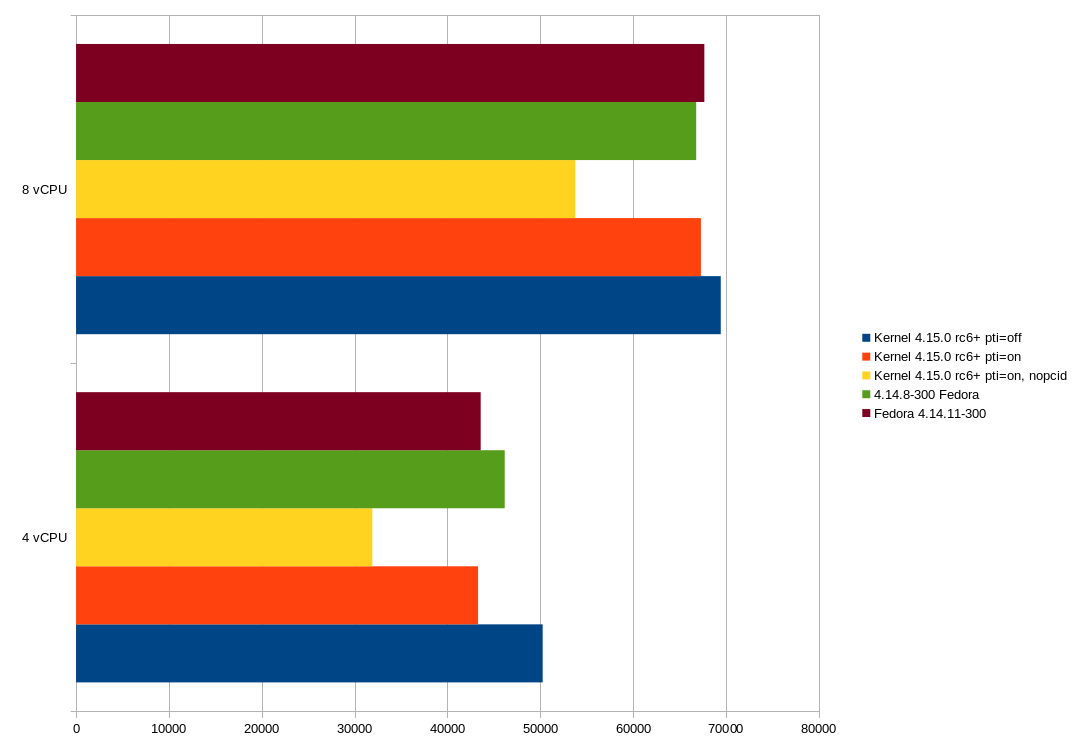
Database users, in particular, are sensitive here, as systems like PostgreSQL® typically cause a high number of context switches under heavy load. At credativ, we classified the impact on a small virtualized system. The basis is a Fedora 27 system as a KVM guest with 4 GByte RAM and fast NVMe storage. However, this plays a rather insignificant role in this test, as the database tests performed with pgbench only have a size of just under 750 MByte. The shared buffer pool of the PostgreSQL® instance was configured with 1 GByte so that the entire database fits into the database cache. The tests were performed with 4 and 8 virtual processors, respectively. The host system has an Intel Core i7-6770HQ processor.
The greatest impact is observed when PCID is not present or is deactivated in the kernel. PCID is an optimization that prevents a flush of the Translation Lookaside Buffer (TLB) when a context switch occurs. Virtual memory addresses are only successfully resolved via TLB if the PCID matches the current thread on the respective CPU. PCID is available from kernel 4.14. The test compares a development kernel with Page Table Isolation (PTI) 4.15.0-rc6, current Fedora upstream kernels with and without security patches. PTI can be deactivated by defining a corresponding argument to the kernel via pti=off during boot.
The Fedora test system already has a very recent kernel (4.14). The difference between the old upstream kernel 4.14.8 without security-relevant patches and the new kernel 4.14.11 is approximately 6%. pgbench then provides the following throughput rates (transactions per second):
If the former standard kernel 4.14.8 of Fedora 27 is taken as 100%, the following results are obtained:
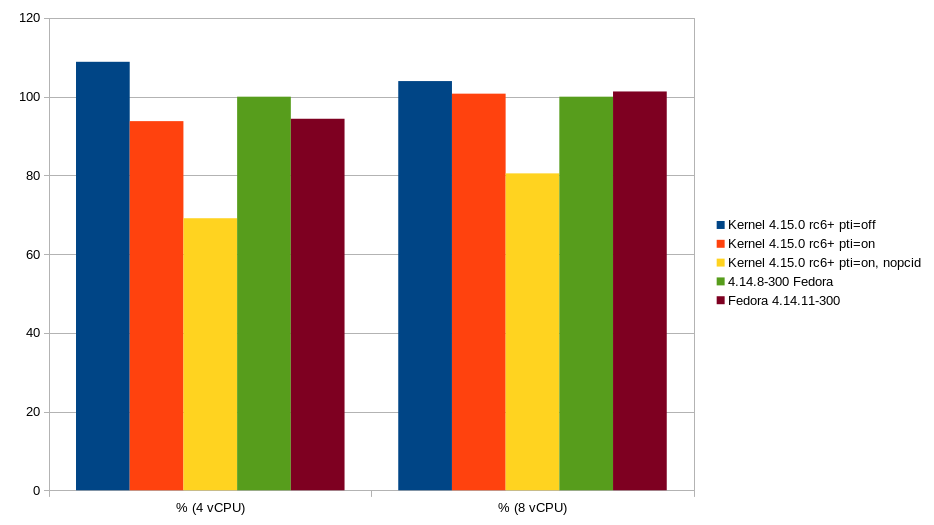
The PostgreSQL® community has also already conducted smaller tests to measure the impact. The results align with our findings. The new kernel 4.14.11 with the relevant patches offers approximately the same performance as the development kernel 4.15.0-rc6 on this platform. In these test cases, 4.14.11 even partially outperforms the old upstream kernel (8 vCPU, comparison 4.14.8, green and 4.14.11, brown). However, the advantage here is just over 1%, so it can be assumed that there are no significant speed differences in this test setup.
For those interested, there is also a dedicated page on the topic. This summarizes all essential information. Also recommended is the summary by journalist Hanno Böck on GitHub, which provides a very good list of all patches for Meltdown and Spectre.
This article was originally written by Bernd Helmle.
| Categories: | News PostgreSQL® |
|---|---|
| Tags: | Kernel Linux Meltdown PostgreSQL® Spectre |
About the author
credativ Redaktion
about the person
Dieser Account dient als Sammelpunkt für die wertvollen Beiträge ehemaliger Mitarbeiter von credativ. Wir bedanken uns für ihre großartigen Inhalte, die das technische Wissen in unserem Blog über die Jahre hinweg bereichert haben. Ihre Artikel bleiben hier weiterhin für unsere Leser zugänglich.
