
Our Visit to Swiss PGDay 2026
| Categories: | PostgreSQL® Events |
|---|---|
| Tags: | PGDay PostgreSQL® |
As a long-standing supporter of the community, credativ participated as an official sponsor. We were pleased to be on-site to meet users, exchange ideas, share our expertise, and contribute to discussions around PostgreSQL and its ongoing development.
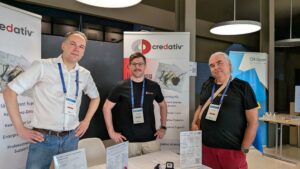
Michael, Tobias, and Josef at the credativ booth
Technical Contributions by credativ
We were pleased to contribute to this year’s conference with a keynote and a technical talk. We were especially proud that our colleague Josef Machytka delivered the opening keynote to a full auditorium.
Josef Machytka – Opening Keynote: “The Next Generation Story of PostgreSQL: From Systems Mechanics to Experience Builders”
Josef’s talk included a more personal element through the involvement of his wife, Katerina Machytkova, who contributed hand-drawn portraits of the historical figures and contributors referenced in the presentation. The slides accompanied the narrative through the different historical phases discussed in the keynote. The presentation combined technical aspects of PostgreSQL’s development with visual and creative elements in the slides.
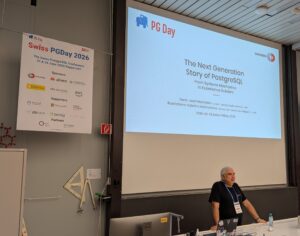
Keynote by Josef Machytka
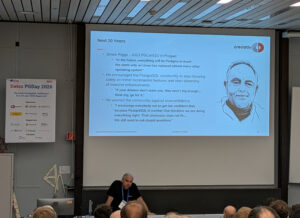
Hand-drawn portraits of PostgreSQL history shown during the keynote
Michael Banck – “Optimizer Hints in PostgreSQL”
Later in the track sessions, our colleague Michael Banck spoke about optimizer hints, a topic that is often discussed in the PostgreSQL community. Unlike some other relational database systems such as Oracle, SQL Server, or MySQL, PostgreSQL does not traditionally expose direct optimizer hints to users. The general approach in core development has been to treat optimizer-related issues as something to be addressed in the planner itself rather than through user-facing hints, which can be difficult to apply in practice in production systems. Michael provided an overview of the different ways the PostgreSQL optimizer can be influenced. This includes adjusting global or session-level configuration parameters as well as using the external pg_hint_plan extension. He also discussed ongoing work related to PostgreSQL 19, which is expected to introduce new mechanisms for influencing query planning. In particular, he referred to a patch authored by Robert Haas that introduces pg_plan_advice and pg_stash_advice. The goal of this approach is to provide a structured way to pass planning-related input to the system without embedding directives directly into SQL statements. Michael illustrated how both the existing pg_hint_plan extension and the upcoming mechanisms could be used to influence query execution plans in complex environments.
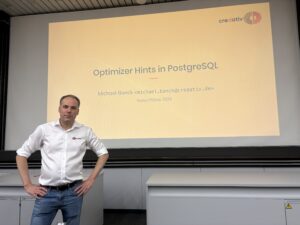
Michael Banck presenting on Optimizer Hints in PostgreSQL
Community Exchange and a Fresh Format
During the conference, we had many conversations at our booth with attendees. We would like to thank everyone who took the time to stop by and talk with us. The direct exchange with participants was valuable for gathering feedback on our PostgreSQL consulting and enterprise support work. A networking evening at the end of the first day provided an opportunity for informal exchange in a relaxed setting. The overall atmosphere was friendly and open, which many participants highlighted during the conference. Beyond our own sessions, Swiss PGDay 2026 introduced a new Birds of a Feather (BoF) discussion format alongside poster sessions and Lightning Talks. The format provided additional space for informal exchange on practical topics and production-related challenges that are not always covered in traditional presentations.
Looking Ahead
Following the event in Rapperswil, we are continuing our plans for the rest of the year. We are preparing our participation in PGDay Lowlands 2026 in Utrecht this September, followed by PGConf.EU in Valencia in October.
| Categories: | PostgreSQL® Events |
|---|---|
| Tags: | PGDay PostgreSQL® |
About the author
Tobias Kauder
about the person
He joined the company in 2021. Since the company's renewed independence, as Team Lead and Manager of the database team, he has been instrumental in its establishment, further development, and operational management. In this role, he guides the team's technical and organizational direction and supports clients with the stabilization, optimization, and operation of database systems, particularly in the PostgreSQL environment and with high-availability architectures.As a dedicated open-source enthusiast, he focuses intensively on PostgreSQL, various Linux distributions, Doom Emacs, and manual tiling window managers like Herbstluftwm. He places particular emphasis on systematic debugging, structured problem-solving, and technical exchange within the team and with clients. He also highly values team balance, as well as the collaborative review and continuous improvement of documentation and technical concepts.