
Notes from PGConf Belgium 2026
| Categories: | Events PostgreSQL® |
|---|
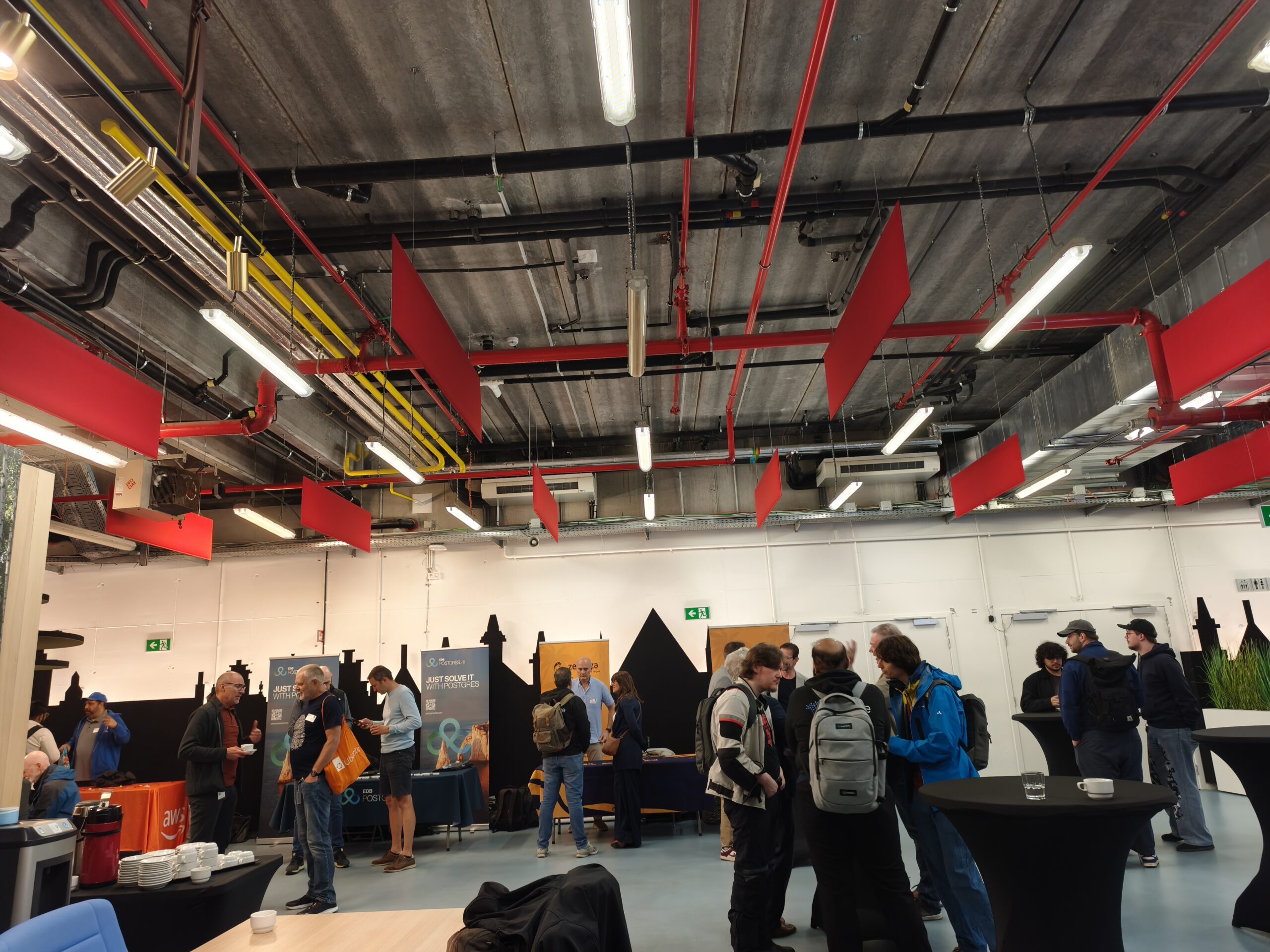
On May 5th, 2026, the Belgian PostgreSQL community and speakers from across the world met for the sixth edition of the PGConf Belgium. The event was hosted at the UCLL Campus Proximus in Leuven, on the grounds of University College Leuven-Limburg, which has been a long-standing host and partner of the conference. PGConf Belgium is a single-day event organized by Wim Bertels (UCLL), An Vercammen (Groep IDEWE) and Giulio Gioffredi (enosac). Attendance is free, but the number of seats is intentionally limited to 120 to keep the atmosphere personal and to leave room for hallway conversations.
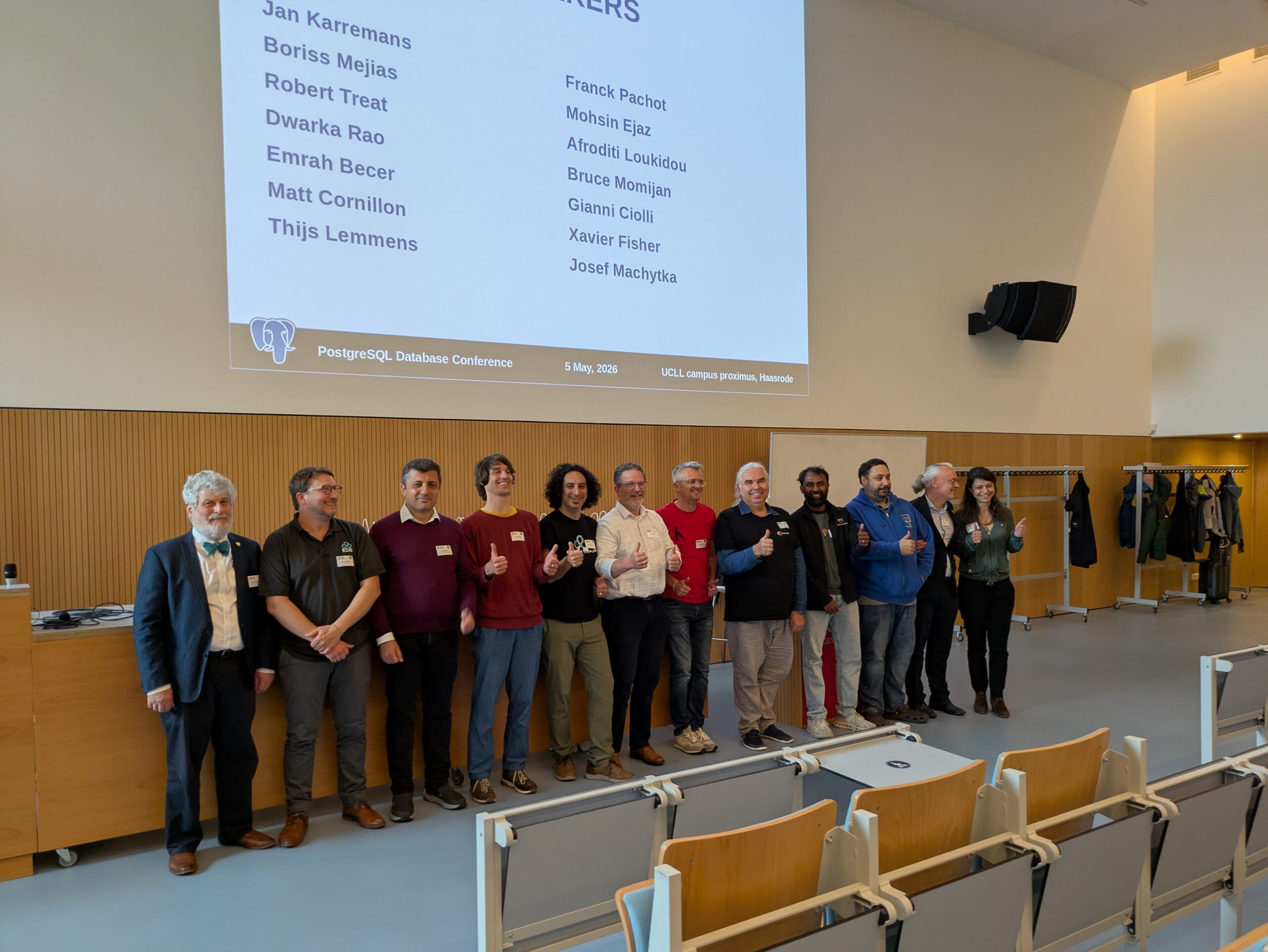
Remarkable Speakers
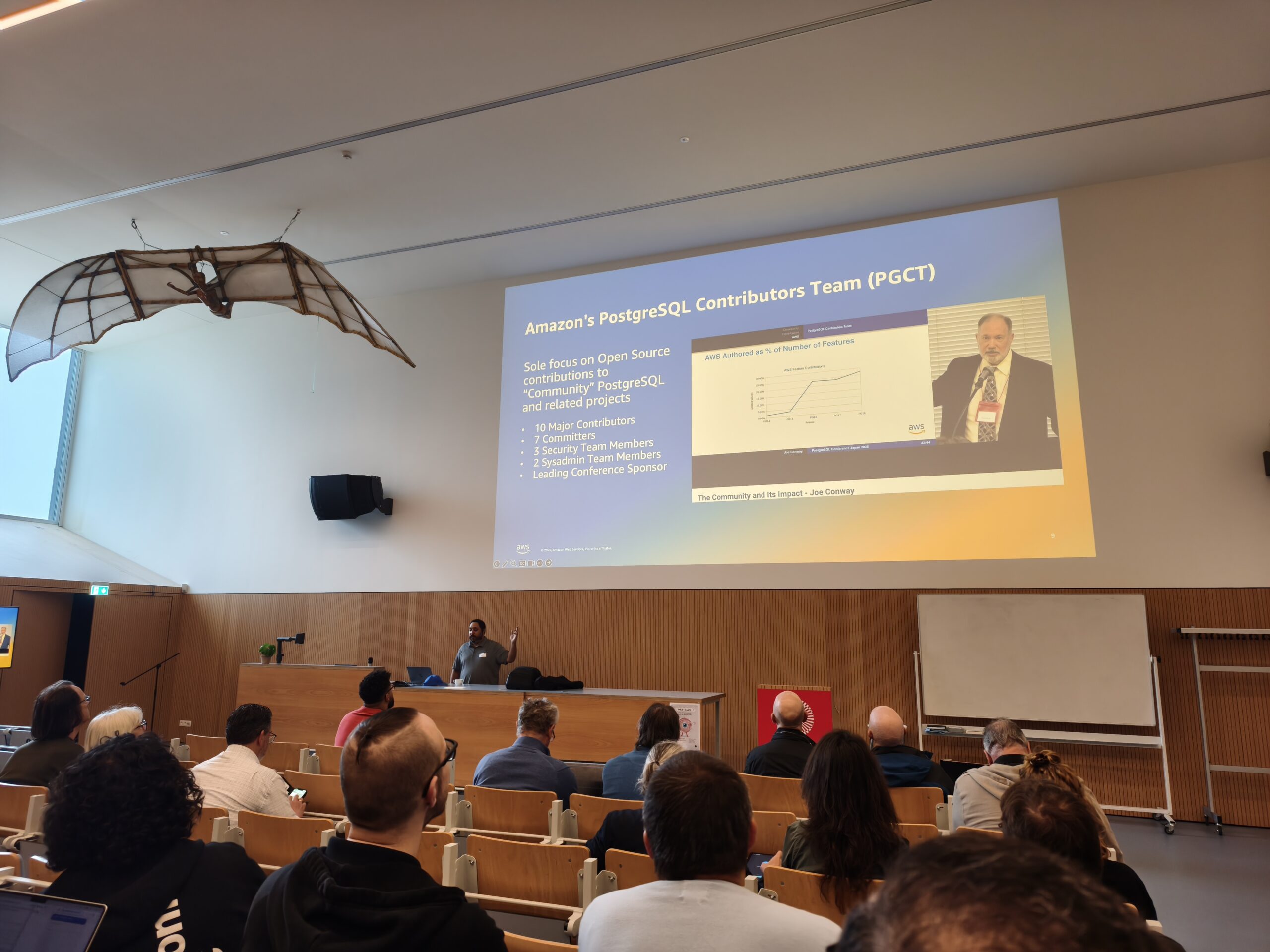
This year’s conference welcomed remarkable speakers. The first one, Robert Treat, a long-time PostgreSQL major contributor, opened the conference with his talk “Postgres @ Amazon” – a retrospective of Amazon’s journey with PostgreSQL. AWS has its own dedicated open source team with several major contributors to PostgreSQL. The talk traced the evolution of open source database offerings at AWS – from the large-scale internal migration off Oracle, to the creation of Amazon RDS for PostgreSQL, and onward to Amazon Aurora for PostgreSQL.
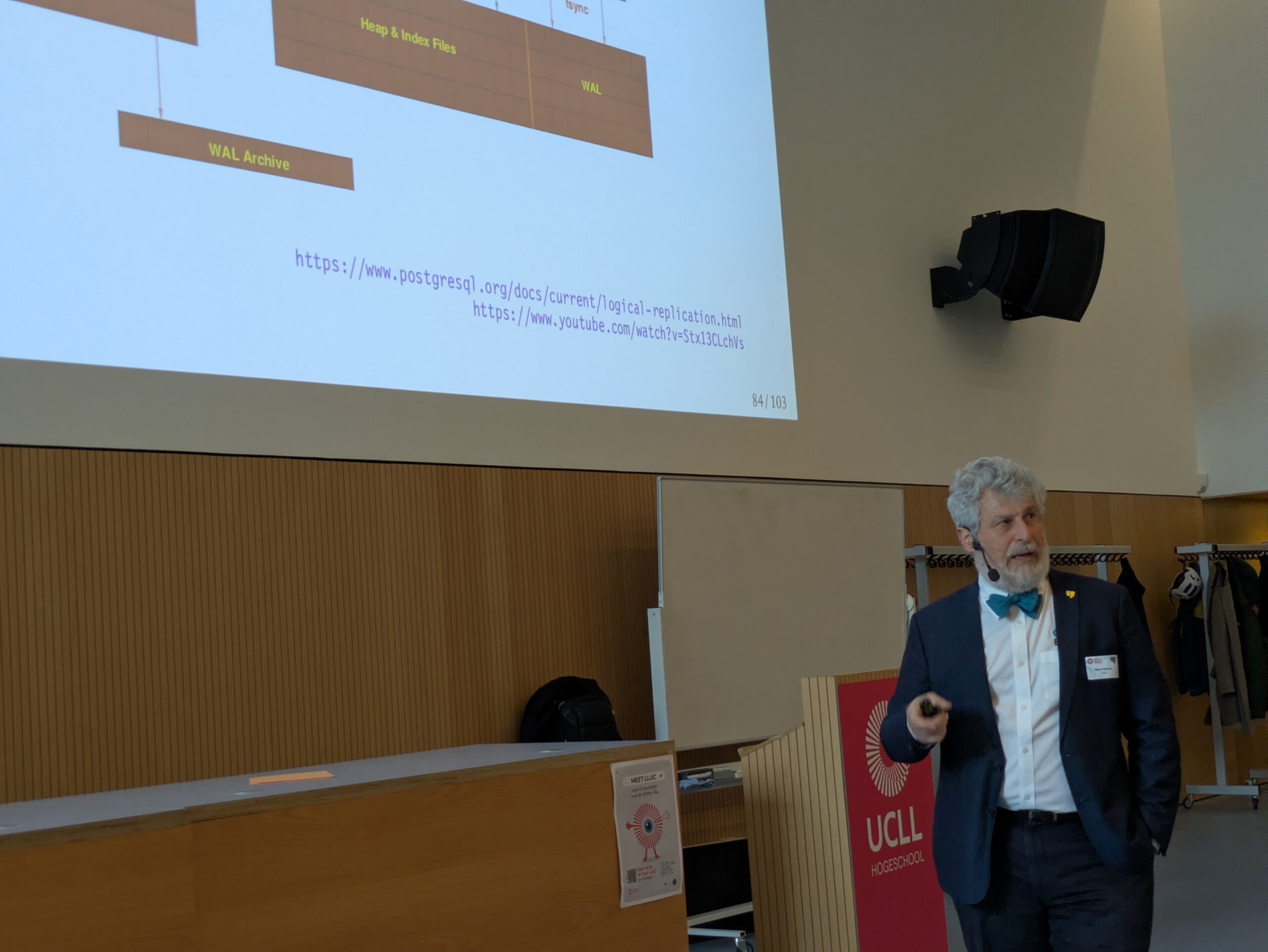
The second one was Bruce Momjian, who delivered a talk titled “The Wonderful World of WAL”. The Write-Ahead Log sits at the heart of crash recovery, point-in-time recovery, binary replication and logical replication. Bruce walked the audience through what is actually stored in the WAL, how binary and logical replication work, and how replication slots track replication progress.
My talk: Migrating Legacy & Proprietary Databases to PostgreSQL
I had the pleasure of representing credativ at this conference with a session titled “Migrating Legacy & Proprietary Databases to PostgreSQL”. European organizations are actively re-evaluating their dependence on proprietary databases, and digital sovereignty has moved from a buzzword to a concrete project requirement. PostgreSQL is, in many cases, the natural target. Drawing on our experience with heterogeneous migrations – from Oracle, MS SQL Server, Sybase ASE, IBM Db2, SQL Anywhere and MySQL towards PostgreSQL – I presented a pragmatic decision framework rather than a rigid recipe. I compared offline strategies (dump/restore, ETL, bulk COPY) against online, near-zero-downtime approaches (CDC, logical replication, dual-write), with special attention to designing reversible cutovers to minimize operational risk. I explained why the size of the database is rarely the biggest issue. The biggest problem is usually the complexity of the existing data model and application, and dependency on vendor-specific features. I also shared specific experiences with migration from IBM Db2, Informix and Sybase ASE to PostgreSQL using our tool credativ-pg-migrator.
Other highlights from the schedule
- PostgreSQL Partitioning: What Works and What Breaks – Dwarka Rao – an honest, practical and production-focused look at PostgreSQL partitioning. Dwarka went beyond syntax to discuss how partitioned tables interact with MVCC, vacuum and autovacuum, why partitioning redistributes bloat rather than eliminates it, and how partition count, size and access patterns affect vacuum scheduling, index maintenance and planning time. Real-world failure modes were on display: over-partitioning, poorly chosen partition keys, vacuum storms, retention jobs causing I/O spikes, and surprising behavior with replicas and logical replication.
- Creating a “Dungeon Master” with Postgres and MCP – Matt Cornillon – probably the most playful, and arguably the most thought-provoking talk of the day, visited by most of the attendees and also by many university students from UCLL. Instead of building “yet another chatbot”, Matt built an AI Dungeon Master for a Dungeons & Dragons campaign, using PostgreSQL as the knowledge base. The session showed how to architect a Model Context Protocol (MCP) server that gives an AI agent secure, contextual access to a PostgreSQL database for complex tasks.
- Deadly Sins when Running CloudNativePG – Boriss Mejías – with his famous sense of humor, Boriss tackled the cultural collision between “classic DBAs” and “Kubernetes folks”. The session focused on practical pitfalls when running CloudNativePG and offered concrete advice for DBAs adapting to the cloud-native world without facing the “Cloud Native Inquisition”.
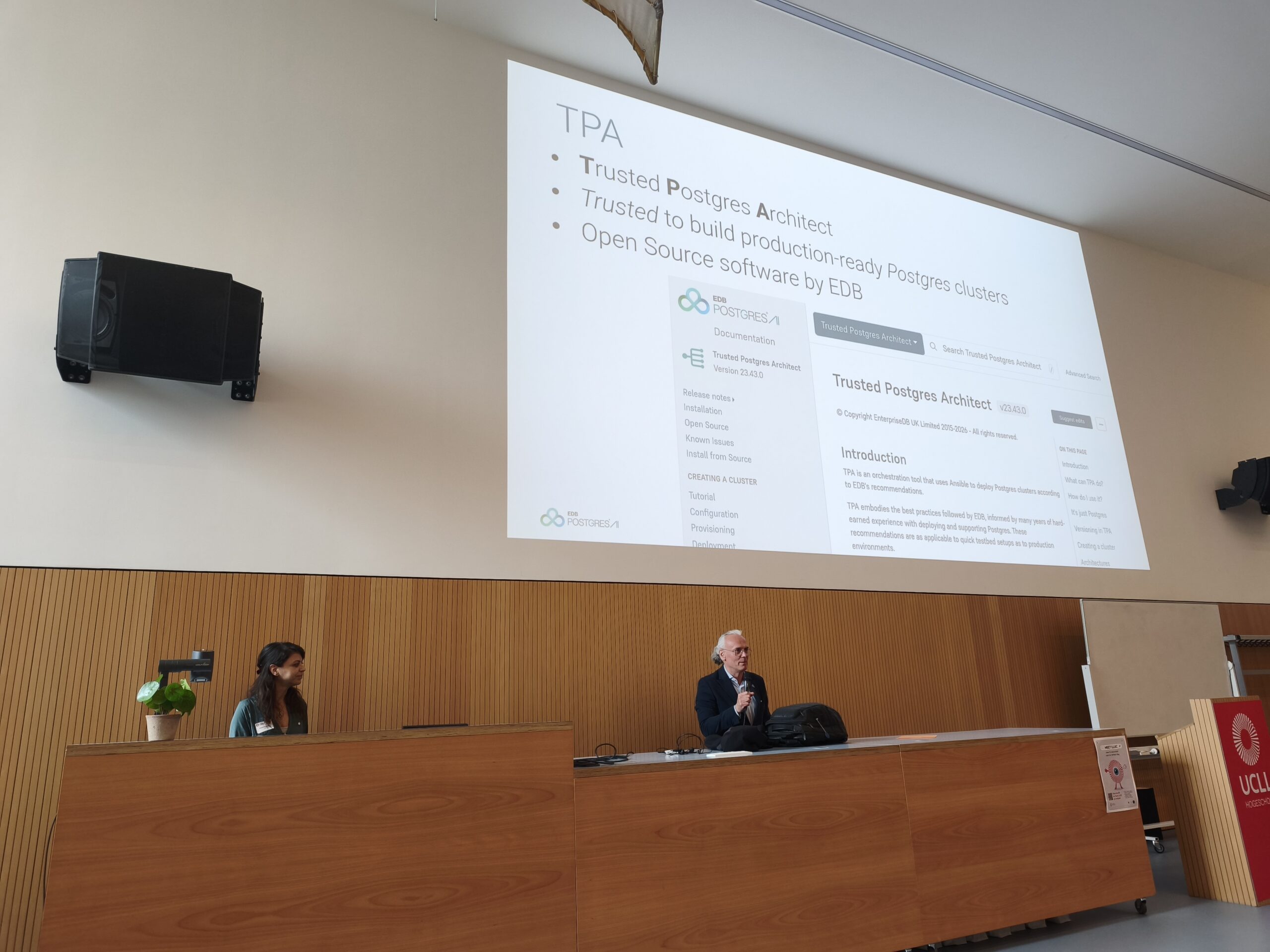
- How to reproduce production environments, and Why – Gianni Ciolli & Afroditi Loukidou – a joint session about reproducibility as a serious engineering discipline. Gianni and Afroditi showed how TPA (Trusted Postgres Architect) can be used to replicate a production Postgres cluster, enabling safer deployments, realistic performance testing and faster incident response. The talk concluded with a practical example of reproducing a production environment and running 1:1 performance tests while keeping cloud costs negligible.
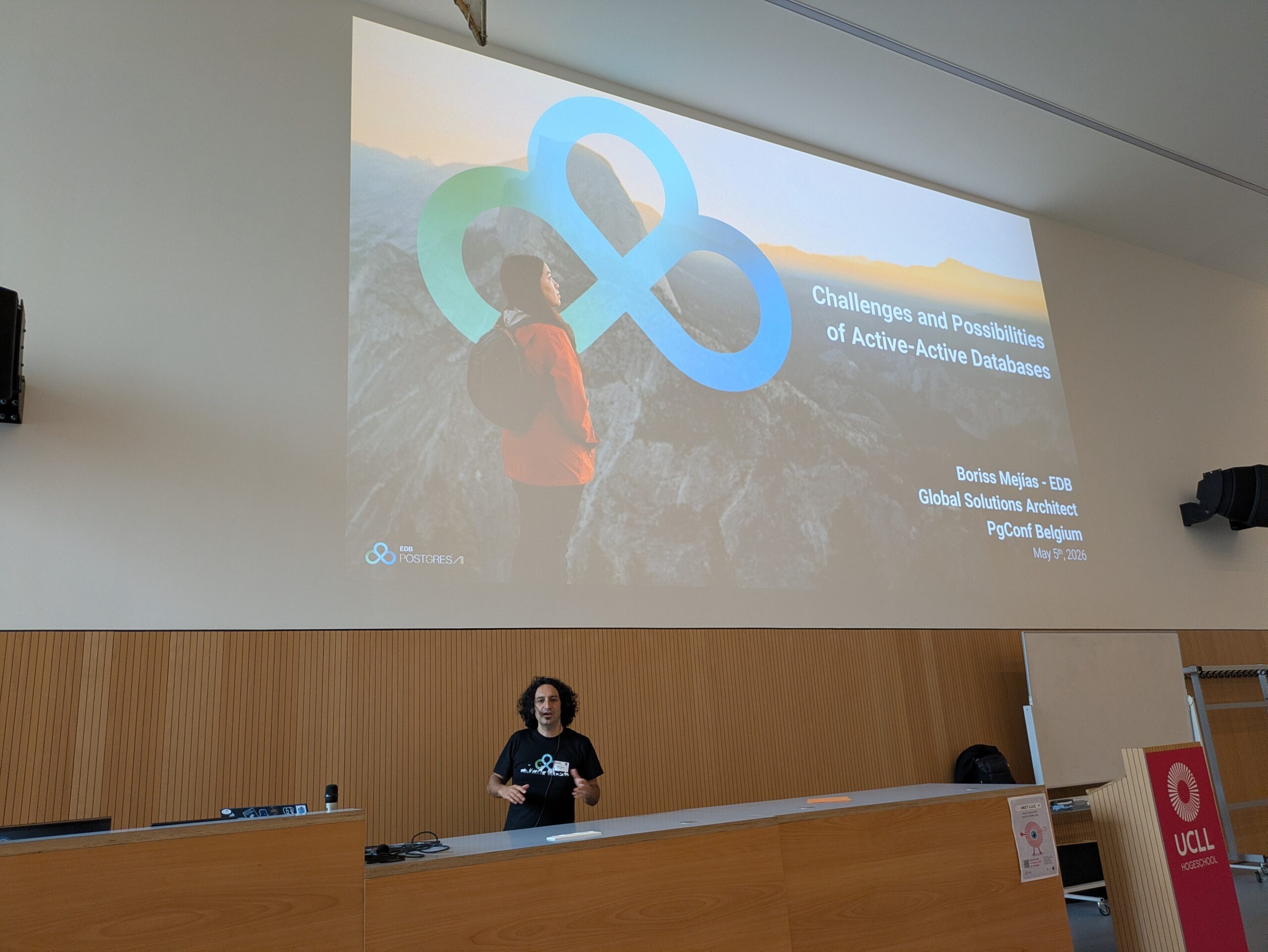
- Closing keynote: Challenges and possibilities of Active-Active Databases – Boriss Mejías – the closing keynote tackled the hard topic of active-active (multi-master) databases. Architects need to understand conflict resolution, consensus, sharding and the broader implications of distributed systems. To keep it concrete, Boriss illustrated the concepts using EDB Postgres Distributed, showing how some of these challenges are solved in practice.
Conclusion
PGConf Belgium 2026 was an excellent conference – technically rich, friendly in atmosphere and perfectly organized. Many thanks to all organizers for the tremendous amount of work that goes into running an event like this on a volunteer basis. Thanks also to the sponsors who make it possible to keep attendance free, and of course to all speakers and attendees for the great conversations. I am already looking forward to PGConf Belgium 2027. If you have not been there yet – mark your calendar next spring. It is worth the trip.
| Categories: | Events PostgreSQL® |
|---|