
What PostgreSQL licensing terms apply?
| Categories: | credativ® Inside PostgreSQL® |
|---|---|
| Tags: | PostgreSQL® |
| AI Disclosure: | This content was created with AI assistance. |
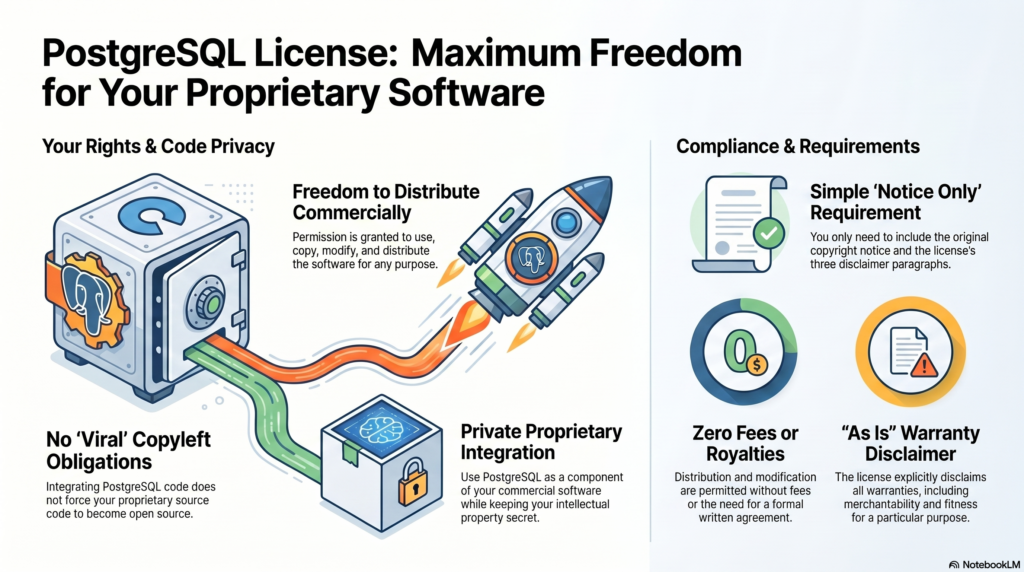
PostgreSQL® uses a permissive open-source license known as the PostgreSQL License. It is based on the BSD license and allows both commercial and non-commercial use without restrictions. Companies can use, modify, and redistribute PostgreSQL free of charge, and only need to retain the original copyright notice.
What is the PostgreSQL License, and why is it so popular?
The PostgreSQL License is a BSD-like open-source license that grants maximum freedom in using the database. It was specifically designed to offer both developers and companies the greatest possible flexibility, without the legal complexities of other licensing models.
This license is particularly popular with companies because it contains no copyleft provisions. This means you can integrate PostgreSQL into proprietary software without having to disclose your own application’s source code. The license dates back to 1996 and has since established itself as a stable, trusted licensing model.
The core characteristics make PostgreSQL attractive for commercial projects: no license fees, no limits on the number of users or installations, and full control over modifications. Companies particularly value the legal certainty and the ability to use PostgreSQL without long-term contractual commitments.
What rights and obligations do companies have when using PostgreSQL?
Specifically, the rights include: unlimited commercial use in any line of business, modification of the source code to meet your requirements, redistribution of both the original and modified versions, and integration into closed, proprietary software solutions without any disclosure obligation.
With PostgreSQL, companies receive extensive usage rights with no significant restrictions. They may use the database commercially, modify the source code, create their own versions, and even sell them. Integration into proprietary software is explicitly permitted.
The obligations are minimal and limited to a few points: the original copyright notice must remain included in all copies or substantial portions of the software. In addition, you must respect the original developers’ disclaimer of liability. Attribution in documentation or About dialogs is not mandatory, but it is appreciated.
- Unlimited use: Commercially in any line of business.
- Modification: Source code may be adapted as desired.
- Redistribution: Including in closed, proprietary products.
How does PostgreSQL differ from other database licenses?
PostgreSQL differs significantly from other database licensing models due to its permissive structure. While MySQL® is licensed under the GPL, Oracle® uses proprietary licenses, and MongoDB® introduced the restrictive SSPL, PostgreSQL remains consistently open and business-friendly.
The comparison shows clear differences: MySQL under the GPL often requires paid licenses for commercial use in proprietary software. Oracle Database generally requires license fees and offers only limited free versions. With the SSPL, MongoDB introduced a license that obliges cloud providers to disclose their entire service software.
For companies, PostgreSQL offers clear advantages: no licensing costs, no legal pitfalls when integrating into commercial products, and no obligation to disclose proprietary developments. PostgreSQL support is also available from various providers, without vendor lock-in effects.
The PostgreSQL License is compatible with almost all other open-source licenses. For example, PostgreSQL code can be incorporated into a GPL-licensed project without any issues.
Comparison of the GNU General Public License (GPL), the GNU Affero General Public License (AGPL), and the PostgreSQL License.
This table highlights, in particular, the differences in the obligation to disclose source code, which is crucial for commercial use and proprietary software development:
| Feature | GPL (v2 / v3) | AGPL (v3) | PostgreSQL License |
|---|---|---|---|
| License type | Strong copyleft (“viral effect”) | Strong copyleft (“viral effect”) | Permissive (liberal) |
| Source code disclosure upon distribution/redistribution | Yes. If derivative works (or combinations) are distributed, the entire source code must be disclosed under the GPL | Yes. As with the GPL, the source code must be disclosed upon redistribution | No. There is no obligation to disclose your own source code |
| Source code disclosure for network / SaaS use (ASP) | No. As long as the software is provided only over a network (without sending copies to the client), the source code does not have to be disclosed | Yes. The AGPL closes the so-called “ASP loophole”. Users who interact with the software over a network must be given access to the source code | No. Source code does not have to be disclosed, neither upon redistribution nor for network use |
| Combination with proprietary software (business advantage) | Not permitted/high risk. Proprietary systems may not integrate GPL code without themselves being placed entirely under the GPL (disclosure obligation) | Not permitted/high risk. Similar to the GPL, but with even stricter requirements for pure network use | Permitted. The software may be used, copied, modified, and distributed for any purpose (including commercial) without license fees and without a written contract |
The key business advantage of the PostgreSQL License
As the table shows, the biggest difference lies in how derivative works are handled and in integration into proprietary software.
The GPL and AGPL are strong copyleft licenses. This means: If you integrate software (such as a GPL-licensed database) into your own software and distribute this combined solution, the “viral effect” applies. Your own software is legally considered an extended work of the GPL software and must also be released under the GPL (including disclosed source code). The AGPL goes even further and requires source code disclosure even if you only offer the modified database as a service (SaaS/cloud) over a network.
The PostgreSQL License, by contrast, is a very permissive license (similar to MIT or BSD). It explicitly grants permission to use, copy, modify, and distribute the software and its documentation for any purpose, without fees or a written contract. The only condition is that the copyright notice and the two paragraphs of the disclaimer remain included in all copies. For a company, this represents a major business advantage: you can easily integrate a PostgreSQL database into a commercial, closed (proprietary) software product and sell it without ever being forced to disclose your own product’s source code.
Please note that this information reflects only the current state of our research and does not constitute legal advice. For a specific assessment of a particular use case, we recommend seeking individual legal advice for the respective case and the relevant jurisdiction.
What should you consider when using PostgreSQL commercially?
When using PostgreSQL commercially, you should follow basic compliance rules to ensure legal certainty. Document PostgreSQL usage in your project, retain copyright notices, and establish internal policies for handling open-source components.
Practical guidelines for legally compliant use include: maintain a software inventory list of all open-source components used, ensure development teams are informed about licensing terms, and store all relevant license texts and copyright notices in a central repository.
To minimize risk, professional support is recommended, especially for business-critical applications. Regular updates and security patches should be planned. Professional PostgreSQL support can help you manage both technical and legal aspects optimally and fully leverage the benefits of the permissive license. For a legal assessment of the licensing situation, please consult your attorney.
Liability
The PostgreSQL License also includes a warranty disclaimer. The software is provided “AS IS”. In our view, recourse against the authors or the project in the event of an error is therefore largely excluded. For this reason, in a business environment you should always safeguard PostgreSQL operations through a qualified service provider, such as the PostgreSQL Competence Center of credativ GmbH. Depending on compliance requirements, this may even be mandatory.
How credativ® supports PostgreSQL implementation
As an ISO 9001 and ISO 27001 certified service provider, credativ® offers comprehensive consulting and support for the optimal use of PostgreSQL. Our expert team helps you fully leverage the benefits of the PostgreSQL License while meeting all compliance requirements.
Our services include:
- Compliance consulting: Integrating PostgreSQL into your commercial software
- Technical implementation: Professional PostgreSQL installation and configuration
- 24/7 support: Continuous support for your PostgreSQL environment
- Migration and updates: Secure data migration and regular updates
- Training: Upskilling your teams on PostgreSQL best practices
Contact us today for a free consultation and learn how you can use PostgreSQL optimally and securely in your company.
Transparency notice:
Oracle® and MySQL® are trademarks of Oracle Corp. MongoDB® is a trademark of MongoDB Inc. PostgreSQL® is a trademark of the PostgreSQL Association, Canada. The mention of these trademarks is solely for the factual description of migration scenarios and services provided by credativ GmbH. There is no business relationship with the trademark owners mentioned with regard to the products referenced.
| Categories: | credativ® Inside PostgreSQL® |
|---|---|
| Tags: | PostgreSQL® |
| AI Disclosure: | This content was created with AI assistance. |

About the author
Peter Dreuw
Head of Sales & Marketing
about the person
Peter Dreuw has been working for credativ GmbH since 2016 and has been a team lead since 2017. Since 2021, he has been part of Instaclustr’s management team as VP Services. Following the acquisition by NetApp, his new role became “Senior Manager Open Source Professional Services”. As part of the spin-off, he became a member of the executive management as an authorized signatory. His responsibilities include leading sales and marketing. He has been a Linux user from the very beginning and has been running Linux systems since kernel 0.97. Despite extensive experience in operations, he is a passionate software developer and is also well versed in hardware-near systems.