
Understanding Open Source Licenses: GPL, MIT, Apache Compared
| Categories: | credativ® Inside |
|---|---|
| Tags: | Open Source Software |
| AI Disclosure: | This content was created with AI assistance. |
Many companies use open-source software without knowing what rights and obligations the respective license—whether GPL, MIT, or Apache—actually entails. Understanding open-source licenses is not purely a legal task, but a strategic prerequisite for any company that develops or deploys software. This guide explains the three most important open-source licenses in comparison and provides you with a practical decision-making foundation for your project.
Note: This article reflects the author’s professional assessment and does not constitute legal advice. For legal advice on licensing matters, please consult an attorney.
What are open source licenses and why are they important?
Open source licenses are legal agreements that define the terms under which software may be freely used, copied, modified, and distributed. They create legal certainty for developers and users by defining clear rules for dealing with the source code. Without these licenses, the use of third-party software would be legally problematic.
The legal significance of open source licenses is immense: they replace the standard copyright, which prohibits any use, with specific permissions. Companies need to understand these licenses, as violations can lead to costly litigation. The internationally recognized reference is the Open Source Initiative (OSI), a nonprofit organization that reviews and certifies licenses based on the Open Source Definition. OSI-certified licenses—including GPL, MIT, and Apache—meet defined minimum requirements for freedom of use, distribution, and source code access. For enterprises, the OSI certification is a reliable signal that a license is legally proven and accepted in the community.
Open source licenses can be divided into two main categories:
- Copyleft licenses (such as the GPL): require changes to be published under the same license
- Permissive licenses (such as MIT, Apache): allow integration into proprietary software without publication obligation
This distinction significantly influences your business strategy and product development. Copyleft licenses promote community development but can restrict commercial models. In the context of copyleft licenses, the term “infectious” conditions is often used, not with a negative connotation, but simply to indicate that by using copyleft-licensed code, derivative works are generally also subject to the same license. A distinction is made between strong copyleft (GPL), limited copyleft (LGPL), and file-based copyleft (MPL). Permissive licenses offer more flexibility for companies that want to develop proprietary solutions.
Important for enterprises: The copyleft effect of the GPL only applies when you distribute the software to third parties. If you use GPL-licensed software exclusively internally, without distributing it, there is no obligation to publish the source code.
What is the difference between GPL, MIT, and Apache licenses?
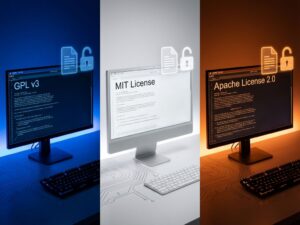
The open-source license comparison between GPL, MIT, and Apache is the first step for many companies in understanding open-source licenses and their practical implications. The GPL license is a strict copyleft license that requires all modifications and derivative works to also be under the GPL. MIT and Apache are permissive licenses that offer more freedoms, with Apache containing additional patent protection. The choice between these licenses determines how you can use the software in your projects.
GPL (General Public License) protects the freedom of software through the copyleft principle. If you use and distribute GPL-licensed software, you must:
- provide or make available the source code
- also place your changes under the GPL
- clearly identify the license terms
The MIT license is the simplest permissive license. It allows virtually anything as long as you:
- retain the original copyright notice
- include the license terms in copies of the software
The Apache license is similar to the MIT license, but also offers:
- explicit patent protection for users
- protection against trademark infringement
- clearer rules for contributions to the software
Practical examples of use: Use the GPL for community projects that should remain open. The MIT license is suitable for libraries that are to be widely distributed. The Apache license is ideal for corporate projects where patent protection is important.
Which license should you choose for your project?
The right open-source license choice depends on your business model, project goals, and desired community participation. Those who want to understand open-source licenses and select the appropriate open-source license should first examine what goals the project pursues and what dependencies already exist. Choose the GPL for maximum openness, the MIT license for maximum distribution, and the Apache license for enterprise projects with patent protection. Also consider the licenses of the software components you already use.
For community-driven projects, the GPL is suitable because it ensures that all improvements benefit the community. This choice encourages contributions from other developers and prevents companies from using your work without compensation.
For libraries and tools, the MIT license is often the best choice. The low legal hurdle leads to higher adoption and more feedback. Many successful JavaScript libraries use the MIT license for this reason.
For enterprise software, the Apache license offers the best balance between openness and legal certainty. Patent protection prevents legal problems and makes the project more attractive to other companies.
Important decision factors:
- Do you want to allow commercial use without an obligation to return?
- Is patent protection relevant to your project?
- What licenses do your dependencies use?
- How important is maximum distribution compared to community control?
Which licenses can be combined with each other?
MIT and Apache-2.0 are permissive licenses and can generally be combined with many other licenses without any problems. Code under MIT can be integrated into GPLv2 or GPLv3. Apache-2.0 is compatible with GPLv3, but not with GPLv2, as GPLv2 does not accept the Apache-2.0 patent clause. GPL licenses are copyleft, meaning that as soon as GPL code is combined, the entirety must be distributed under GPL. GPLv2 and GPLv3 are not mutually compatible, unless a project uses the “v2 or later” option.
Crosstab: Compatibility / Combinability
| Combination | MIT → other | Apache‑2.0 → other | GPLv2 → other | GPLv3 → other |
|---|---|---|---|---|
| MIT | ✔️ | ✔️ | ✔️ | ✔️ |
| Apache‑2.0 | ✔️ | ✔️ | ❌ not with GPLv2 | ✔️ compatible |
| GPLv2 | ✔️ | ❌ | ✔️ under GPLv2 | ❌ except “v2 or later” |
| GPLv3 | ✔️ | ✔️ | ❌ except “v2 or later” | ✔️ |
Overview
Here is a summary of the three major open-source license models:
| Function | MIT | Apache 2.0 | GPL (v2/v3) |
|---|---|---|---|
| License type | Permissive | Permissive | Strong Copyleft |
| Derived works | Can be closed source | Can be closed source | Must be open source |
| Patent protection | No explicit clause | Yes (grant/retaliation) | Yes (v3 only) |
| Attribution | Note required | Note required | Note required |
| Primary goal | Maximum flexibility | Legal certainty | Protection of the ecosystem |
GPLv2 vs. GPLv3: Why the Version of Your GPL License Matters
GPL Version 2 and GPL Version 3 both pursue the goal of ensuring software freedom, but differ in several key aspects. GPLv3, released in 2007, addresses technical and legal developments that were not yet considered in GPLv2 from 1991. An important difference is the handling of Tivoization: Manufacturers provide the source code, but technically prevent users from running modified versions. A classic example is a digital video recorder (such as the namesake TiVo) that uses GPL software but only accepts firmware signed by the manufacturer. Users can view and modify the code, but cannot install their changes on the device – a clear contradiction to the spirit of the GPL. The GPLv3 explicitly prevents this.
In addition, GPLv3 strengthens protection against software patents, improves license compatibility, and takes greater account of international legal spaces. Overall, it expands the freedom of use, while GPLv2 is considered more stable but less comprehensive.
Special cases
The AGPL dilemma: Protection vs. ecosystem
Switching to the Affero GNU Public License (AGPL) or even to specific “Source Available” licenses—as can be observed in prominent examples such as MongoDB (SSPL) or Elasticsearch (ELv2)—seems tempting at first glance in order to protect one’s own business model against commercial use by large cloud providers. In practice, however, this path often proves risky: such licenses frequently lead to legal uncertainty for corporate customers, a fragmentation of the developer community, and the loss of official “Open Source” status according to the OSI definition. Instead of sustainably protecting the project, there is a risk of undermining precisely the collaborative dynamics and trust that made the software’s original success possible in the first place. In fact, we are seeing a blanket rejection of such licenses, especially among large companies. In particular, the AGPL is very often found on a blacklist.
LGPL – Lesser GPL
The Lesser General Public License (LGPL) was also developed by the Free Software Foundation (FSF). The LGPL allows developers or companies to incorporate software under LGPL into their own projects without being forced to disclose their source code as a whole due to a so-called strong copyleft. However, end users must be able to change the LGPL-licensed code, which is why this code in proprietary software is usually outsourced to dynamic libraries that can also be replaced when the program as a whole is only available in binary code. The license represents a compromise between the various strict copyleft licenses such as GPLv2 or v3 on the one hand and permissive licenses such as MIT or BSD licenses on the other.
BSD and Mozilla Public License: Additional Relevant License Types at a Glance
In addition to GPL, MIT, and Apache, there are other open-source licenses that are regularly encountered in practice. In particular, the BSD license and the Mozilla Public License (MPL) are widely used in certain project contexts and deserve separate consideration. A basic understanding of these license types helps you correctly assess dependencies in your projects and make licensing decisions more confidently.
BSD License: The Permissive License for System-Level Software and Maximum Freedom
The BSD license is one of the oldest permissive open-source licenses and imposes even fewer requirements than the MIT license. It originated in the Berkeley Software Distribution, a Unix derivative from the University of California, and is now primarily used in two variants: BSD-2-Clause and BSD-3-Clause. Both variants require only the retention of the copyright notice and a disclaimer of liability; BSD-3-Clause additionally prohibits the use of the original developers’ names for advertising purposes without express permission.
Typical use cases for the BSD license are operating system components, network software, and Unix-like systems—many parts of BSD-based operating systems such as FreeBSD or OpenBSD are under this license. In terms of compatibility, the BSD license behaves similarly to MIT: BSD-licensed code can be integrated into GPLv2 and GPLv3 projects without any problems and combined with Apache-2.0.
Mozilla Public License (MPL): File-Based Copyleft as a Middle Ground
The Mozilla Public License 2.0 offers a middle ground between permissive licenses and strong copyleft: only the files that contain MPL-licensed code must be kept under the MPL—the rest of your project can be under a different license, including proprietary licenses. This concept of file-based copyleft makes the MPL particularly attractive for companies that want to contribute individual components to the open-source community without having to disclose their entire product.
Well-known projects under the MPL are Mozilla Firefox® and parts of LibreOffice®. As for compatibility, MPL 2.0 is explicitly compatible with GPLv2, GPLv3, and Apache-2.0, provided the respective files are correctly marked. For projects that want to incorporate MPL-licensed code, however, it should be noted that the disclosure obligation at the file level must be consistently observed.
Does an open-source license contradict every business model?
The clear answer is “No!” Open-source software and commercial business models are not mutually exclusive—on the contrary, thousands of successful projects show that open source code and economic success are very compatible. Which model fits best depends on your goals, your target audience, and the chosen license.
SaaS Model: Open-Source Development with Commercial Hosting
In the SaaS model, software development takes place entirely under an open-source license, while a commercial provider offers the software as a hosted service. Users benefit from the transparency of the open source code, but pay for hosting, maintenance, and support. A very well-known example is the blogging software WordPress®: the source code is freely available at https://wordpress.org/, while https://wordpress.com/ offers hosting and paid additional services such as cloud storage and backups. The advantage lies in broad community participation; the disadvantage is that competitors can also host the software.
Dual Licensing: Free and Commercial License in Parallel
In the dual licensing model, the same software is offered simultaneously under a free open-source license and a commercial license. Companies that want to use the software in proprietary products can purchase a commercial license that includes additional guarantees or extended usage rights. This model makes it possible to serve the open-source community while generating revenue from the commercial segment. The disadvantage is that managing two license tracks creates organizational overhead.
Open-Core Model: Community Edition and Full Version
The open-core model provides a community edition under an open-source license, while an extended “full version” with additional features is offered commercially and proprietary. In the community, this model is less popular, as it often results in only a small developer community voluntarily contributing to further development—the incentive to contribute to a project whose core features are commercially withheld is naturally lower. For providers, however, the model offers a clear monetization strategy.
Service and Consulting Model: Expertise Around Open-Source Software
In addition to product-based models, there is the option to sell services and consulting around open-source software. The software used remains completely open source, while companies pay for design, implementation, operation, and support. This is exactly the approach we take at credativ®: we advise clients for a fee on how they can implement their infrastructure with open-source software and support them in ongoing operations—consistently relying on pure open-source solutions.
But isn’t open-source software always free?
No, open-source licenses do not prevent the commercial distribution of software. However, they sometimes force the source code to be published, which may promote competitive products, but it is not necessarily free. Richard Stallman once formulated this as “Free as in free speech, not free beer.” In addition, a TCO analysis always includes costs for conception, rollout, and operation. These are just as present with proprietary software. However, open source offers the advantage that you get a high degree of independence with the source code, which means that you are not in a vendor lock-in trap if the provider massively increases prices.
What about software without license information?
Software without explicit license information is legally fully protected in most legal systems (“all rights reserved”). This means that users may neither use, copy, modify nor pass on the code, even if it is publicly accessible, for example on GitHub. An explicit license is therefore always necessary for permitted use.
Anyone who consciously wants to make software public domain can do this via CC0 (Creative Commons Zero). CC0 waives copyright claims – as far as legally possible – and enables almost unrestricted use without conditions.
It is important to distinguish between Open Source / FOSS and Public Domain: Open Source does not mean “free of rights”, but describes licensed software that grants certain freedoms of use (e.g. MIT, Apache, GPL). The Public Domain, on the other hand, is actually free of copyrights, either through the expiry of the protection period or through explicit waiver as with CC0.
What happens if you misuse open source licenses?
License violations can lead to costly litigation, claims for damages, and the obligation to publish your own source code. Common mistakes include ignoring copyleft provisions, missing license notices, and using incompatible licenses in a project. Preventive measures such as license audits protect against legal problems. There are also specialized service providers and software offerings that take over the analysis of the code used.
Legal consequences of license violations are diverse:
- Cease and desist orders that can stop your software distribution
- Claims for damages for lost license fees
- Obligation to subsequently publish the source code
- Attorney and court costs
Common mistakes in practice arise from a lack of awareness:
- GPL software in proprietary products without source code publication
- Removal or modification of copyright notices
- Mixing incompatible licenses without considering the implications
- lack of documentation of used open source components
Companies can protect themselves by conducting regular license audits, training developers, and using tools for automatic license detection. A clear guideline for the use of open source software helps to avoid problems from the outset.
Various software tools are also available for license audits, some of which are offered commercially or as SaaS. But of course, there are also various open-source tools that support you in the license audit. As an example, we would like to mention the following here:
- FOSSology – an open-source license compliance system that already supports code scanners during the development stage to avoid introducing unwanted license combinations.
- AboutCode ScanCode describes itself as an industry-leading SCA code scanner and can also be integrated into build pipelines for automatic code scanning.
license checkeris particularly exciting for web or web-related developers, as it fits seamlessly into the npm / npx universe.
Of course, the list does not claim to be complete and, as always, can change again and again in the open-source environment.
License Compliance in Daily Business Operations: Processes and Responsibilities
License compliance is not a one-time task, but an ongoing process that must be organizationally anchored. Many companies only react to license violations when legal consequences are imminent—yet most risks can be significantly reduced through proactive measures. Establishing structured compliance processes not only protects against legal problems, but also creates internal clarity about which open-source components are in use and under what conditions they may be used.
The following measures form the foundation of a robust open-source compliance program:
- Establish an open-source policy: Define internally which licenses are allowed, restricted, or completely prohibited in your projects. Such a policy provides developers with clear guidance and prevents problematic licenses from entering your codebase unnoticed.
- Introduce Software Composition Analysis (SCA): Integrate automated SCA tools into your development cycle to continuously capture open-source components used and their licenses and check for compatibility. Tools such as FOSSology or ScanCode can be integrated directly into build pipelines.
- Train developers regularly: License obligations are unfamiliar territory for many developers. Regular training ensures that your team knows the basics and acts in compliance with licenses in daily project work.
- Clearly assign responsibilities: Designate a responsible person or role—such as an Open Source Officer or compliance manager—who maintains an overview of the licenses used and serves as a point of contact for license questions.
Building such structures requires experience and a deep understanding of the open-source license landscape. This is exactly where we support you at credativ®—from developing a tailored open-source policy to implementing appropriate compliance processes in your company.
How credativ® helps with open source licensing issues
We support companies in the practical use of open source software through comprehensive consulting and practical implementation assistance. Our team of Linux specialists and open source experts knows many pitfalls and helps you avoid them while making the most of the benefits of free software.
With over 20 years of experience in the open source field, we understand both the technical and legal challenges. We help you to use open source software safely and effectively in your IT infrastructure without taking legal risks. Our comprehensive services cover all aspects of open source consulting.
Contact us for a non-binding consultation on your open source deployment. Together, we will develop a strategy that harnesses the innovative power of open source software for your company.
| Categories: | credativ® Inside |
|---|---|
| Tags: | Open Source Software |
| AI Disclosure: | This content was created with AI assistance. |

About the author
Peter Dreuw
Head of Sales & Marketing
about the person
Peter Dreuw has been working for credativ GmbH since 2016 and has been a team lead since 2017. Since 2021, he has been part of Instaclustr’s management team as VP Services. Following the acquisition by NetApp, his new role became “Senior Manager Open Source Professional Services”. As part of the spin-off, he became a member of the executive management as an authorized signatory. His responsibilities include leading sales and marketing. He has been a Linux user from the very beginning and has been running Linux systems since kernel 0.97. Despite extensive experience in operations, he is a passionate software developer and is also well versed in hardware-near systems.